Konāje(pronounced koNāje) is a growing suburb in southern Mangalore that hosts the sylvan campus of University of Mangalore. In normal circumstances, we may analyze the place- name Konaje as Kona+ aje, the village of buffaloes. This also may be realistic considering that buffaloes have become essential parts of the evolution of Karavali culture that has been preserved in the tradition of Kambala the annual buffaloe race conducted in slushy paddy fields.
However there is another set of Konāje village in northeastern part of Mangalore taluk(with Padu (=western)and Mudu(=eastern) rural fractions) that shows derivation of the place name from 'Kodanji' or the pillar rocks.
Kodanj kall
Kodanjikall (pronounced koDanji- kall) is a regionally conspicuous rocky granitic hill with twin curvy peaks on the Mudabidri to Shirtadi route in Mangalore taluk. The 'kod' stands for pillar like standing rock column(s) whereas the 'anji' and 'kall' refer to land and rock. A land with natural rocky pillars is Kodanji-kall. The equivalent village name in Kannada, however, is 'Konjae'. The Konaje that has been split into 'Padu Konaje' (=western Konaje) and 'Mudu Konaje'(=eastern Konaje).
But the application of Kodanjikall as well as paDu/muDu Konjae to the same rural stretch suggest that the word Konāje is derived from Kodanji.
D.> N transition
The unusual D > N transition with passage of time from the original Tulu word 'koDanji' to the Kannada word 'koNāje' is interesting.
Unless we have additional historical documents to support, it may not be possible at this juncture to prove whether the D> N transition was atleast partly influenced by the alternate origin of the place-name namely, the buffalo – land.
®

A heritage blog by: Ravindra Mundkur & Hosabettu Vishwanatha
Tuesday, September 16, 2008


Saturday, September 6, 2008
146. Kudroli to Katapadi- Enagudde
Some of the ancient place-names have been deformed or misinterpreted with passage of time. Reader Ranjan pointed out how Kuduru-bottu hamlet on NH 17 has been mis-translated as Kudure-bottu. The Tulu word 'kuduru' referred to island with the river. But the word 'kuduru'(=island) was confused with 'kudure'(=horse) and consequently the original meaning was lost during translation of the place-name into Kannada.
Kudroli
Similar error has been made in case of the popular place known as Kudroli within Mangalore city. Some translators explained it as Kudure-oli or what they describe as 'a horse yard'. But the original meaning of the word Kudur+oli(=island+hamlet) has historical. and paleo-geographic significance. Several centuries ago the Kuduroli was an island village within a river that dried up during subsequent period. Geological evidences suggest that the historical changes and shifting of the river course rendered the place dry during the early centuries of the Common Era!.
Thus Kudroli is a fossil word that traces the forgotten past paleo-geography of the land that has not been documented otherwise for lack of historical documentation in the region!
Katapadi
While discussing the erroneous interpretation of place-names, Katapadi comes to the mind because of a hilarious misinterpretation. The word Katapadi in Tulu is a pun. The verb 'katapādi' means to tie down. Some people have visualized a fictious story involving a legendary King of Manipura, a small village south of Udupi, who presumably conducted an Ashwamedha (horse-sacrifice) ceremony to propitiate Gods and the place where the designated horse was tied down to a post was said to have named as 'Katapadi'.
However, the actual designation of the word Kāt+pādi (=wild farm) is different and unconnected to this anecdote. There are similar place name of Kaat-padi in Tamilnadu, suggesting that it was an ancient name during the early stages of civilization..
Enagudde
A connected place-name near Kat-padi is Enagudde. It has been misinterpreted as Hengudde, the hill of corpses! Again this is not the original meaning attributed to the place by our forefathers. Ena in place names such as Enakallu, Enagudde etc refer to vertically standing piece of rock. The word 'Ena' (=vertical pole like rock) or 'Eni' (=ladder) needs to be understood properly in the light of the existence of such place names in other parts of Karnataka, specifically with vertical pillar like rock structures. Due to changes in time and tides the vertical rock pole in Enagudde might have collapsed, but the name still reminds us of the pillar rock of the bygone days.
Friday, September 5, 2008
145.Partheno
One of the words that impressed me after reading Dr Abhaya Kaukradi's (1997) work on 'Mugeras' is 'partheno'. The Mugera word 'partheno' is equivalent of the Tulu word 'paD-dana'.Both these words refer to the oral form of folk-songs.
Note the similarity between the words 'Partheno' and the Sanskrit 'prarthana'(=prayer). Abhaya suggests that Mugera tribes are related or similar to Mundala tribes. Thus we can infer that Mugera and Mundala are part of the Early Munda group of tribes. The Early Munda language and culture apparently predates Dravidian and Indo-Aryan presence in India.And therefore the possibility of some of the ancient Munda words being used as substrates in later Indo-Aryan/Dravidian words cannot be ruled out. Consider for example:
Partheno.> Prarthana
Partheno.> PaD-dana
I would like to consider the possibility that the words Prarthana and PaD-dana may have been derived or influenced from the apparently older word Partheno.
®
Thursday, September 4, 2008
144. Mabukala
A place on the northern bank of River Seetha close to NH 17 in Udupi taluk is known as MabukaLa. The significance of the place name Mabukala lies in the fact that it is different from Mayikala or Ayikala we discussed previously.
kaDa.>kaLa
The suffix 'kaDa' in Tulu is an abbreviated form of the word 'kadapu' or 'kadapu kariya' (the ferry or ferry bank), the place used by people in the olden days to cross the river on boats. The Marakada for example was an ancient ferry point.
However, in the parts of Karavali, north of Udupi, Kannada became the prevalent official language especially during and after the rule by Vijayanagar Kings. Consequently many of the original Tulu words and place-names got translated into Kannada.Under the spell of Kannada, the original Mabukada became Mabukala!.
Mābu
The ferry was named after Mābu, probably the boat-man who used to ferry people across the river. Mabukala is located in a historically significant region that encompasses the ancient State of Barkur and several Moolasthanas on the banks of Rivers Seetha and Swarna and their confluence near Hoode-Bengare beach.
Mābu, the boatman who ferried people across the river must have been a popular person during a specific period in the early history as the place has been cited in some of the paD-danas.
®
Wednesday, September 3, 2008
143.Billadi
Billadi is a village in Udupi taluk near Yadthadi that carries the relic signature of ancient Bill or Bhil tribes in the Karavali.
The Bhils are now a predominant tribe in the forests of Madhya Pradesh and adjoining sylvan region. Once upon a time they were widespread in the peninsular region also. They were also employed historically in the regional armies of Marata and Rajput Kings for their expertise in guerilla warfare.
Bhils of Karavali
Basically, they were archers ('bhil' or 'bill'=bow) which was a part of the hunter stage of early human evolution. The word 'bill '(the bow) has been a common word in several southern languages including Kannada. Thus the Bhils of Karavali were later known as 'Billava' probably during Vijayanagara and subsequent period of 'Kannadization' of Karavali. However, the equivalent word for Bhil in Tulu is 'biru' and the 'Billava' are popularly known as 'Biruver'.
Baida
Even today the native doctor among the tribes are called 'Baida'. The word 'Baida' forms the basis for the later evolved word 'Vaidya'. The mother of legendary heroes Koti-Chennaya was known as 'Deyi Baidethi' and she was proficient in the native system of herbal medicine. The Tulu word 'Baider' has been evolved from the tribal word 'Baida'. The ancient 'Baida' were the pioneers of Ayurveda system of medicine in India.
Valmiki
Bhils of central India assert that Valmiki the composer of Ramayana was a Bhil. The simplicity of the core story of Ramayana thus leads us to infer that the base of Ramayana was a tribal story that was fashioned into an immortal epic by the gifted poet-composer Valmiki.
®
Tuesday, September 2, 2008
142. Pandesvara, Manjesvara..
Ishvara is God (Isha/eesha= master,lord; vara=great, supreme).But we have a large number of place names that end with the suffix of -Ishvara .The list includes Pandesvara, Manjesvara, Neelesvara, Rāmesvara, Lakshmesvara, Dharesvara, Murudesvara, Mahabalesvara etc. The names are obviously among the numerous epithets for the Lord Shiva, and especially for the temples dedicated to Shiva at various places but their application as place-names in various parts of South India may have evolved out of a different word origin.
Pandi and Manji
There is one interesting analogy between the two place names Pandeswara and Manjeswara. Apart from the fact that both of these places are on the coast, they carry the names of the country cargo boats (Pandi and Manji) that were popular in the past. It can be deduced that the Shiva (Iswara) temples in these two port towns were built by the cargo boat owners,and the 'Ishvara '(isha-avara? =divine temple) were built after the names of cargo boats!
Brahmāvara
Compare the place name Brahmāvara with Pandesvara or Manjesvara. Āvara (<.ār) is large yard and thus Brahmāvara is an open-yard or place dedicated to the Lord Brahma.
Similarly, the various 'Isha-avara'-s should have been originally the places or yards dedicated to Manjesha-, Pandesha, Murudesha- Rāmesha- etc.
Pāndeshāvara?
A temple dedicated to Ishvara by the Pandya King, Pandesha must have been Pandeshavara. A temple dedicated to Manjesha should have been Manjeshavara.
However, It appears that the original 'Ishāvara' places were misinterpreted, reinterpreted or stylized later as -'Ishvara' and the places were referred to as 'Manjesvara' (alternate spellings: Manjeshvara or Manjeswara), 'Pandesvara' and so on instead of Manjeshavara, Pandeshavara etc..
®
Saturday, August 30, 2008
141.Village name suffixes
The usual word-suffixes for designating villages in Dravidian languages in southern India are -oor, palli/ halli, grama, naaD, koppal etc. However, the Karavali region has a large number of somewhat unusual village name suffixes that evidently represent specific trends in evolution of words some of which are common to all the south Indian languages. The Karavali during the various early historical periods being a settlement of assorted tribes with their own languages, we can expect input of primitive words from their languages that have formed the base from which the present set of words were evolved. Note some of the delicate implication of evolutionary trends in the following place indicators.
Ar.> Avara
It has been suggested that the Indo-European root word 'Ar' as in Aryan represents agriculture or cultivation. However similar root is found in Dravidian languages. For example 'ārankei' represented the open palm of the hand, for example, in Kolami (Dravidian)language. The word 'ārankei' later became 'angai '(palm of hand) in various Dravidian languages. Thus we can deduce that original root 'ār' or 'āran' meant open area or field.
The natural open fields that facilitated as the human settlements during the early civilization were possibly designated with the suffix -ar. There are a large number of villages/hamlets in Karavali that have the suffix -ar. For example: Todar, Bolar, Kemar, Mijar, Mudar, Madar, Palar, Pilar,Ubar etc. And Arantodu, Arambodi Arabail etc.
With passage of time the ār was converted to -āra or -āru. (Bantara, Bolāra, Kantāra, Kemaru, Mijaru etc).
New words were created later in time span by adding short modifying prefixes. For example: mār (m+ār) meant agricultural field, probably slightly elevated than ār.(For example: Malemar, Bakimar, Palimar, Palemar, Barimar etc) Similarly kār( k+ ār) represented wooded field(Ajekar, . And jār (j+ ār) for sloping ground. The -gār and -chār became variants of -kār and -jār. For example Alangar, Kannangar, Mangar, Kodichar, Kolchar etc.
Further innovation, especially Sanskritization modified and refined the ār hamlets into -avara. (Attavara, Udyavara, Banavara, Mangalavara Neelavara, Pejavara etc).
r.> L With passage of time, probably during Vijayanagar and later period, with conversion of r.> L, the 'mār' beacame 'māLa'. Names like MāLa, GomāLa, ErumāLa etc came into being.
aDi.> adka
The suffix 'aDi' possibly originally referred to cool shade of a tree, that was later extended to mean huts,hamlet or habitation etc. Nelyādi, Kalyādi, Manjanādi, Nekkilādi, Amtādi, etc An variant of -aDi was -aDa. For example Kokkada.
The PāDi (pa+aDi;= farm) developed from -aDi. Examples: Kukkipādi, Bellipādi, Baikampādi etc. In some areas -pāDi has become -bāDi. For example: Kannambādi, Kodimbādi,etc..
The suffix 'aDka', evolved from -aDi, and means open ground or yard. Possibly, it developed later as a regional variant of the suffix-ar. Examples include Kudthadka, Aladka,Pāladka, Kalladka, Mulladka, etc.
Al
The suffix -al or its later forms -ala , -alu or āL meant water course, river or stream. It was employed to represent land area or field by the side of a stream. Bajāl, Kaipunjāl, Kudala, Koppalu, Alupe, Alike, Aluve, Pāngala etc. The -sāl (s+āl), -jāl (j+āl) , -vāl (v+āl) and -chāl (ch+āl) became the modified variants of -āl. For example: Nadisāl, Kodijāl, Heranjāl, Ilavāla etc.
aN
The āN is an another basic suffix (with its later variants -aNNu, or -aNe) that represented soil, land or field. For example: Belman, Muddān, Kemman, Kondāna, Kodmān, Kokkarne, Perne, Marne etc.
Also the words KonkaNa, PaDuvaNa(=western), MooDaNa (=eastern), tenkaNa (=southern )etc.were formed in this fashion. So, the word 'konkaNa' refers to notched/crooked coastline between Goa and Gokarna: konk(crooked, hook-like,non-linear)+aNa (land).
Naturally, the common word maNNu (=soil) is a compound of m+aNNu. (Similar analysis can be extended for the word 'haNNu' (=fruit), the agricultural product.
Anj.> Aje
The -anj or -anje (along with its regional variant -ang) was one of the ancient basic word that possibly suggested developed area, shops or township. Possibly the root word '-anj' originally meant 'a sloping ground ' or 'hill-slope' as we find that in the Kolami-Gadaba languages the word 'anj' means climb.
Several zone indicators were evolved from the basic word - anj , such as:
banja. (=barren/dry)
kanja (=reddish )
kunja, (=hilly)
manja (=even land)
nanja, (=farmland)
punja, (=rocky)
renja ...(=fragrant/delightful)....etc.
Many of these words were compounded with -ar into Kunjar, Manjar (>Manjarur), Kenjar, Banjar etc.
The words angar( Naiki language), angari (Naikri language ) and angad (Parji language) mean courtyard or bazaar in ancient Dravidian languages.Thus the word 'Mangar' (m+ang+ar=Ancient Mangalore) could be an earlier variant of the word 'Manjar' (m+anj+ar) or Manjarur. The word 'angar' was an ancient equivalent of 'angadi', the bazaar. The words 'angār' and 'angaDi' (=bazaar) (as in Haleanagdi, Uppinangadi, Belthangadi, Hosanagadi Koppalangadi, Murathangadi, Mudarangadi etc) were in turn derived from --anj or -ang.
Some of these words were modified in later period. For example 'manja' (as in Ballamanja, Kalmanja) became 'maja' as in '-majalu.'(as in Kanakamajalu).
Similarly 'kanje' became 'kaje', banje .> 'baje' with passage of time.
Land classification words like nanja, punja etc are used even today in Kannada also. Examples for village names embodying -anj derivatives include: Markanja, Balkunje, Elinje, Heggunje, Kudkunja, Kedinje, Innanje, Bannanje, Surinje, Kunjathabail, Punjālkatte, The 'nanja' became 'nancha' (as in Nanchar) in some areas.
Ank, ang
The -anj had two variants namely : -ang and -ank. The -ang/e and -ank/i variant of -anj/e can be examplified by Varanga,Kodange, Parenki, Neranki, Pernakila etc. The-ank (=yard, small piece of land; e.g. Koli-anka) evolved into place names such as Manki (m+anki), Permanki etc. Even the word Lanka (island) can be considered as ( l+anka or the land within water; la- being shortened form of al/a=water). The 'ank' later evolved to represent the 'number'
The 'anj' root word with passage of time became '-aj 'or '-aje'. Variants of 'aje' include Aje(<.anje), Kaje(<.kanje), maje/majalu (<.manje) and Baje(<.banje). Village names such as Ajekār, Baje, Bajāl, Bajape Kaje, Kajekār, Konaje, Pāthaje, Derāje, etc abound in the Karavali.
Oli
The suffix word -Oli or -OLi could be of Prakrit origin as it has been traced to Marati areas as a village indicator. For example of -Oli are: Innoli, Maroli, Kudroli, etc.
One of the possibility is that the suffix '-goLi' in many of the village names (like Bajagoli, Kinnigoli, Goliangadi, Taudugoli, Asaigoli etc) could actually be a derivative of Oli (g+oli) rather than the goLi, the banyan tree, as commonly presumed so far!
Odi
The suffix Odi apparently has several meanings as enlisted in the Tulu nighantu. However, it could be geographical indicator of 'bettu' (upland) is suggested by the Kannada equivalent name 'Hosabettu' of the original Tulu place name 'Posodi'. Examples of Odi villages include Odipu, Posodi, Arambodi,
The Odi could be a regional variant of Oli as we find analogy between Oli>goLi and Odi >k+ODi, ODu>> k/g+oDu.
Further variants of -Odi are -kODi (Kodi. Aluvekodi, etc). And for -Odu and -koDu or -goDu or -toDu., we find examples in Kumragodu, Balgodu, Kasarkodu, Kasargodu, Arantodu etc.
Oor
The origin of the word oor can be traced to the name of the renowned ancient Sumerian city, Ur , that dated back to some 6000 BCE. The names of ancient Indian historical cities Mathura (Uttar Pradesh)and Madhuarai (Tamilnad) were based on the root word -ur or -oor.
Now the suffix -oor is the most common indicator (Mangalur, Bengalur, Maisur,alur, Belur, Begur, Puttur, Tumkur, Kittur, Nellur, Chittur, etc) of village/town/city names in southern India.
An old form of -oor was -uri. Place names like Naguri, Hebburi (Hebri), Uruval, etc. were based on these. The -uri form apparently was used by ancient Munda tribes as one of their language was called Naguri.
Pu.>pura
There are a number of ancient village names that end with -pu or- pe. For example:Alape, Didupe, Bajape, Belapu, Mudipu, Kudupu etc. The -pe suffix was altered to -be in some areas. (Example Perabe). The original -pe or -pu possibly represented township. Later on the -pu suffix was merged with -ur that probably led to the formation of Sanskrit suffix 'pura' (p'+ ura) as in for example Kundapura, Kalyanpura, Manipura, Sakleshpura; Kanpur, Nagpur, Jaipur etc.
Se
The suffix -se has become a place indicator in several village names such as Avarse, Vaddarse, Teggarse etc. The -se suffix could possibly be a regional variant of -pe.
Readers may offer their opinions or disagreements if any on the above topic.
®
Subscribe to:
Posts (Atom)
A Coastal estuary
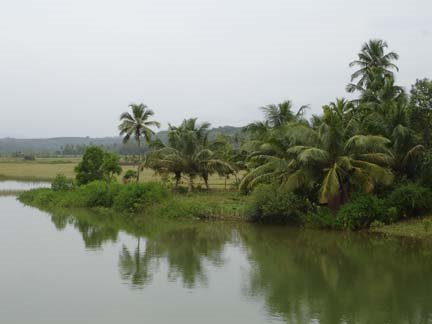
Holegadde near Honavar,Uttara Kannada dist, Karnataka
Copy? Right - but kindly remember to acknowledge!

" tulu-research.blogspot." ತುಳು ರಿಸರ್ಚ್. ಬ್ಲಾಗ್ಸ್ಪಾಟ್. ಇನ್

Have a nice day !