The present delimitation of Tulu speaking areas along the Karavali especially to the south of Udupi appears to be a feature imposed on the region after the Vijayanagar administration (ca 14 century CE and thereafter) centered on Barakur that fostered administrative support for the growth of Kannada in the region around and north of Barakur. Before Vijayanagar era in the Karavali, Kadamba rule centered on Banavasi ca. 4th century CE laid the foundation for growth of (old) Kannada in the northern Karavali.
A few words still prevail in the northern Karavali in support of the above claim. And Airodi is one such place name.
Airodi
Airodi (pronounced AayiroDi) is a village close to the northern banks of River Seetha near Hangarkatta in Udupi taluk. Hangarkatta was a traditional boat building centre in the Karavali.
Ayere in Tulu stands for river bank. Possibly the word originated as aa+ere meaning the other edge of river.(Compare 'ayere' with Attavara, Aamai etc words that refer to the place on the other side of the river.)
Therefore the place name Airodi literally represents an Odi (village) on the Ayere (the river bank).
Airoli
A similar sounding village Airoli exists in coastal Maharastra. The Oli (pronounced OLi) is a Prakrit/ Marati word generally representing a village or habitation and the word is also found in Tulu.(Note the Tulu village names like Kudroli, Maroli, Budoli etc). The existence of names like Airoli in Maharastra suggests that the word 'ayere' was more widespread in the earlier days along the west coast.
It is possible that the Tulu word -Odi is an variant of the word -OLi or vice versa.
Written with: Hosabettu Viswanath
®

A heritage blog by: Ravindra Mundkur & Hosabettu Vishwanatha
Saturday, October 25, 2008


Wednesday, October 22, 2008
158. Pandyas & cargo boats

A wooden nagaa under construction at Ullal. A white arrow inserted shows the size of a man for comparison
Panemangalore and Pandimar, the place names, hold key to the ancient boat based trade culture of the Karavali. The word 'Pandi' (= a large cargo boat) appears to have been connected with ancient rulers of the south known as Pandyas. Apart from the Pandya Kings that ruled parts of Tamilandu during historical period, several Alupa Kings of Tulunadu have adorned the title of Pandya. The 'Pandya' surname appears to have been derived from the word 'Pāndi'. The capital of Pandyas, the original Madhurai, as well as those of Alupas were coastal port towns. It is logical to presume that ancient rulers of the coastal lands were affluent traders who employed large boats to ferry their merchandise to various destinations. Thus the ancient Tulu -Dravida coastal people were proficient in building huge boats to transport food-grains and other items on sea-route and coastal fluvial courses . Large tree trunks woods were cut down in the dense forests of Western Ghats and were transported downstream to coastal boat making centres through the major rivers like Nethravati.
Oda
The common 'Oda'(d as in dog) is a narrow linear wooden boat employed to traverse through rivers as well as used for fishing in the sea. On the analogy of morphology (shape) of Oda, the Tulu village name /suffix 'Odi' (as in Odipu, Posodi, Niddodi etc) can be described as a lane like habitation with houses arranged in a linear fashion.Odi can have several other shades of meaning like sloping land:it also may be an equivalent of the word 'Oli'(Compare village names 'Airoli' with 'Airodi'). As suggested by Hosabettu Viswanath the 'Oda' apparently evolved later into 'Ota', the run.
Besides 'Oda ', there are a number of words that describe large sized cargo boats in Tulu. Words like Pāndi, Koti, Nagā, Manji, Padavu and Kappāl were in usage to refer to large cargo boats implying that the ancient Tulu people were proficient in marine trade and navigation. Note that most of these words also reflect a large size or a huge number.
Pāndi , Pandya
Pandi is large boat used to carry merchandise and the boat-owner was usually known as Pandia or Pāndya. The legend of Bhutala Pandya highlights the life and times of a Pāndi owner or Pāndya. There is a suggestion that some of these Pandia were rich fishermen who were also experts in sea-faring and sailing cargo boats.
Pāndyas of Tamilnadu as well as Tulunadu (Alupa Kings)adopted the insignia of twin fishes. Adoption of this insignia might have been conncted to their heritage of fisherfolk /sailor culture or it may have been derived from the roots of fish worship cult of Sindhu- Saraswathi (Indus valley) civilization.
Sediyapu Krishna Bhat suggested that the surname Pandya or Pandia was originally applied to the owner of the large boat known as Pandi. Pandya were one of the the earliest dynasties that ruled ancient Tamilnadu. He has also proved that the word Pandi was once a Dravida word widespread in southern India. The place names Pondicherry and Pondi Bazar in Tamil areas are obviously the relics of the ancient Dravida word Pāndi.
Pandi probably was known in Gujarat coast also as pointed out by Sediyapu. The 'Pānde' surname popular in northern India might have been an offshoot of the word 'Pāndi'.
Bandi
Another interesting point is that the word 'Pandi' is related to or evolved to 'Bandi' (p>b transition) which now literally represents a wheeled vehicle, but originally the word banDa meant goods or merchandise and therefore 'banDi' meant a goods transport vehicle. Note the word 'banDasāle' (d pronounced as in 'dog') in Tulu represents a store-house.
Koti
Koti (t pronounced as in tea) is a large boat like Pandi. The funny expression 'KoTi or PānDi' is used by Tulu people usually as a pun. A Koti also represents a store-house or large number ( a crore or one hundred lakhs). However the personal name of 'Koti' (of Koti- Chennya fame)is said to have been derived from the name of deity Kotilingeswara.
Nagā
Nagāa also means a hill. The word was applied to (1) a hill-like large boat (2) a boat carrying valuable goods that brought cash to the owner of the boat upon trade transactions. The word nagā also evolved later to represent valuables like gold and jewelry ( as in 'naga nattu' ) or currency (as in 'naga nānya'), The Dravida word for cash 'nagad' is also derived from the word 'nagā'.
Manji
The words 'manjā' or 'manji' in Tulu meant a raised structure or elevated land and it was also applied to large sized boats. So the original word coined by the Nātha monks at Kadire (Mangalore) for the deity Manjinatha (later refined to 'Manjunatha') actually referred to the God of the heights, the heights possible connoted either the Mount Kailas ( the Himalayas) and/or the 'manja' or 'manji' (elevated plateau of the Kadire hills.
Of course there are words apparently of different origin but sounding similar to 'manji' with dissimilar meanings like (1) 'manj' or 'manji', the dew or fog and (2) 'mānji' a flat fish, known also as pamphret.
®
Friday, October 10, 2008
157. Panemangalur
A small town on the bank of Netravathi River in Bantval Taluk is known by the name of Pānemangalur. Sediyapu Krishna Bhat has discussed the origin of this place name in a work cited at the bottom of this post..
Pāner
Pānemangalur is called Pāner in Tulu. Fishermen call this place as Pāndimār. Sediyapu suggested that the name 'Pāner' is derived from Pāndimār. Padekallu Vishnu Bhat cites that Dr.G. R. Rai proposed that Pāner is a modified form of 'Pāndiyer'. The 'yer' suffix denotes that Pāndi boats were lifted on the river-bank field to be parked in the the raised field.
On the other hand,since the 'ār' suffix in Tulu (and other Dravidian languages) represents a field,the Pāner may have simply been derived -colloquially- from Pān(d)yār < 'Pāndi+ār', the parking field of pāndi boats.
Pāndimār
'Pāndi' is a large cargo boat used to transport merchandise since early history in various ports of southern India. 'Mār' is an expansive agricultural field. The Pāndimār therefore implies a large field used for anchoring or parking large cargo boats known as Pāndi. During the earlier history River Netravathi was extensively used for navigation and transportation of goods. Goods were transported on Pāndi boats from Panemangalore to Mangalore along the river Netravathi. During the off-seasons the Pāndi boats from Mangalur (Mangalore) were parked at Pāndimār. Thus the village was called Pandimangalur which was later shortened to Panemangalur.
Mār
Sediyapu has a special explanation for the word mār, the agricultural field. He suggests that mār is a abbreviated form of 'timar' the field. In my opinion mār is an independent Tulu word representing expansive fileds, Bākimār, Pālemār, Mālemār etc. The 'timār' possibly means wet field as indicated by 'timare' the aromatic herb that rampantly grows in wet fields.
Mala, Yermal
The r > l conversion of phonemes in Tulu during medieval history is well known. The 'mār' became 'māl' with passage of time as exemplified by the village name 'Māla' ( pronounced māLa) and Erumala (Yermal) and the words 'gomāla' (=pasture reserved for cattle grazing) etc.
*
Hosabettu Viswanath adds :
"A bit of information about 'Pandimar'. Keel is an important part of a boat. Hence strong and sturdy wood is used. This is made of fully grown and large tree trunks, which were available aplenty in forests of Ghat sections. Such crudely carved tree trunks were rowed through Netravathi River and sea and brought to coastal destinations. I have seen such tree trunks brought to Hosabettu for building country boats. I have heard elderly people sitting in sea-shore shelters, i.e. 'dompas/chappars' made of coconut leaves, and telling anecdotes about their trips and cutting jokes about Goudas and their admirable hospitality."
®
Thursday, October 9, 2008
156. Bondantila
An village in Mangalore Taluk is known as Bondantila.
In Proto-Kolami-Gadba langauges the word 'bonD'- referred to toddy palm or the palmyra. Therefore the place name Bondantila stands for a village with many palm trees.
In Tulu the word 'bonDa' refers almost exclusively to the tender fruit of coconut palm.Apparently th word 'bōnDa' was extended further to represent a round shaped oil-fried dish popular in south Indian restaurants.
®
Wednesday, October 8, 2008
155. Lathande
Origin of some of the common words in our usage are plainly mysterious! The name of the common pulse 'alasande' is a word based on a Greek name Alexander or Alexandria!
Alasande
It appears that the familiar slender, tubular, long bean sheathing the 'black-eyed pea' pulse or 'cow-pea' (Vigna unguiculata) known as alasande, originally from Africa, was apparently introduced to India by the Greeks and it was named after the ancient Greek hero Alexander or the Greek town of Alexandria. Read Manjunat's relevant note on Alasande.
The word 'alasanda' is said to be a Pali word that was absorbed into most of the Dravidian languages during the period of Budhism in south India.
The word has undergone several serial modifications in Tulu such as Alasande, Alsande, Alathande, Lathande, Lathane etc.
Alasangi
A word cited in Tulu Lexicon 'alasāngi' which means a woman, apparently does not have clearly deduced origin. Like the long beans 'alasande' this word might also have been derived from or related to Alexandria or the Greeks.
®
Friday, October 3, 2008
154. Sin to Chennaitodi
Evolution has been an integral feature of human civilization that can be recognized in the sequential growth of words and concepts in tune with the passage of time. Migration of human beings on continental scale in the historical past has propagated and dispersed some of the basic words and concepts in diverse territories. Ponder over the evolution of the ancient word Sin,(or Suen) the Sumerian-Babylonian Moon God and its evolution into Chen,Chenne,Chinna, China, Chennai and Chandra etc.
The connection between the words Sin and Chandra has been documented earlier by scholars like Prof. Rajawade and Sham Baa Joshi.
Sin, the Moon God
Early Sumerian civilization (2000-4000 BCE) worshipped Sin (=Moon) as a supreme male God. The Sin or Suen has been considered as an word of Akkadian origin. According to Sumerian legends Sin married Shamash (Sun, female)and had son called Ishtar (Venus,the morning star). The Moon God Sin was represented in Sumerian mythology as an old man with flowing beard and crescent as symbol. Moon temples were popular during the time of Abraham (ca.2000 BC) at the towns of Ur and Harran. The crescent symbol was also adopted by later religions like Islam. Sinai region in Arabian peninsula was named after the God Sin.
Moon and Sun
Some of the authors have pointed out that the Moon worship related to early pastoral society whereas Sun worship was characteristic of later agricultural society. Indian races believed that they belonged to the clan of Moon (Chandra Vamsha) or the clan of Sun (Surya Vamsha). The Dravidians were generally considered to belong to the Moon's clan and Aryans asserted that they hailed from the Sun's clan. Interestingly, the crescent symbol was also adapted in India as an ornament in the tied-up hairs of the popular Indian God Lord Shiva, the Ishwar.
Shen, Chen, China
The Sin God was later had name variants like Sinim, Shen or Chen. The word Sinim is considered to be relevant to Chinese people. Similarly the surnames Shen and Chen are very common surnames among the people of Chinese descent. Basically the name of the country China itself appears to have evolved from the word Chen.
Chinna
Possibly the word Shen or Chen was applied people with golden yellow skin. Besides the Moon God was known for beauty. The word Chen also was adapted in Dravidian languages as Chenna (=beautiful) and Chinna (=gold).
Chenne
Chenne was an ancient board-game originated in Africa as discussed in earlier posts. The game of Chenne was considered to have mystic divine powers and was played on specific ocasions.It was popular in Tulunadu since the legendary days of Siri. The Siri paDdana appears to be contemporaneous of the Tamil Sangam literature that possibly dates back to beginning of the Common Era.
Chennai, Chennaitodi
The Taml place name Chennai, now a Metropolitan city, is an offshoot of these words suggesting a beautiful city (initially dedicated to Moon God?). In a sense Chennai is similar in meaning and aspiration to Afro-Arabic land of Sinai. However, the word Chennai is not exclusive to Tamil. A village in Bantval Taluk is known as ChennaitoDi (D pronounced as in dog).
Schendra
Moon has been represented in Rigveda as Schendra. It is a compound of S/Chen+indra, the Indra being leader of early Aryan Gods.(Compare with Sin, the leader of Sumerian pantheon). Rigveda also cites two versions of Moon such as: Raka, the Goddess of Full Moon (Poornima) and Sinivali, the crescent on the eve of New Moon.
The Schendra gradually became Chandra in Indian parlance. Another word Chandrama was also used. Again it has been considered as a combination of Chandra+Maas, the Maas representing Moon or the lunar month.
®
Thursday, October 2, 2008
153. Ambala-mogaru
Ambala-mogaru near Konaje is a village on the southern bank of River Netravathi. There are other villages in the region like Ammembala. Both these place names contain 'Ambala'(= temple) a word of Malayalam origin. The word appears to be popular in transitional areas between Tulunad and Kerala since the word Ambala is not quite common in northern Tulu region.
Ambala
The word Ambala possibly referred to shrines dedicated to the Mother Godess, under the matriarchial system of society. The 'Amba' in Ambala refers to the Mother Goddess. The Amba appears to be an ancient Prakrit word borrowed into Malayalam and Tulu. The '-la' suffix in the word employed to denote the 'shrine' is interesting. Was this '-la' suffix an attenuated version of 'ila' the habitation,.'illa' the house or 'ala' the river? The word Ambāla also exists in northen India as a place-name.
Ammembala
The other place name Ammembala is also interesting. Whether the 'amme' in Ammembala connotes 'father' as in Tulu or 'amma', the mother, needs to be studied.
Ambalapadi
Ambalapadi near Udupi again reflects another temple village, where the term Ambala specifically refers to the Mother Goddess, Kali.
®
Subscribe to:
Posts (Atom)
A Coastal estuary
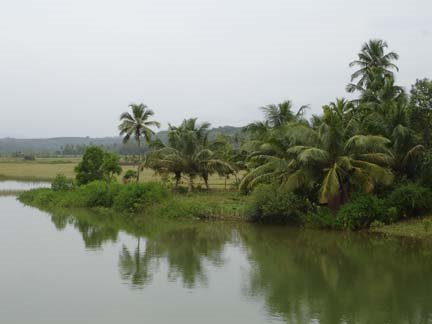
Holegadde near Honavar,Uttara Kannada dist, Karnataka
Copy? Right - but kindly remember to acknowledge!

" tulu-research.blogspot." ತುಳು ರಿಸರ್ಚ್. ಬ್ಲಾಗ್ಸ್ಪಾಟ್. ಇನ್

Have a nice day !