Deepavali is a very popular festival in India and the significance is explained as a celebration symbolic of our innate aspiration to progress towards light from darkness, towards knowledge from ignorance and towards prosperity from poverty. It is also described as a festival of thanks-giving to the Mother Nature. Deepavali means array of lights.
In spite of this modern, positive-thinking style of explanations, the fact remains that the festival was originally conceived and celebrated by his subjects as an annual welcome- back ceremony for their beloved exiled King Bali. King Bali variously described as Baliyendra or Bali or Maha-Bali or Bali Chakravarthy (emperor).Remnants of what was originally a pan-Indian custom in ancient days of early civilization remains even today in Tulunadu and Kerala.
Vamana incarnation
The legend of King Bali and Vamana, the dwarf, has been absorbed into Purana-s, with Vamana considered as one of the incarnations of Lord Vishnu. (cf. Post 34: Ten incarnations).According to the viewpoint of Vishnu’s followers, Bali (a follower of Shiva cult) was pictured as a despicable Asura who deserved to be subjugated. This was in conformity with the Sura-Asura conflict of pro-Vishnu and pro-Shiva cultures in ancient India.
However, the other side of the story is more interesting and throws light on the theological-cultural conflicts during the early historical period.
Asura King Bali
What was the great sin done by this Asura Bali?
He was a philanthropist to the core, who willingly gave away free gifts to the needy people!
If we brush aside all humanly impossible fantasies woven into the said legend, the remaining core story is that King Bali, was fond of giving away gifts desired by the recipient! The standing offers was that Bali would give whatever is asked of him! One clever, dwarf beggar (Vamana) came and begged him to grant land enough to place his three steps.(Or maybe, he asked that he should be given wherever he places his steps ).King Bali agreed to provide him whatever the dwarf desired and the mischievous Vamana placed his foot on Bali’s head! Thus, Bali had no other choice than offer himself to the wishes of the dwarf, who sent him to exile to a place called Patala.
The word ‘bali-daan’ (means ‘sacrifice’, but literally ‘gift of Bali’) might have been coined from the self-sacrificing act of King Bali.
Patala
The concept of Patala in Purana-s, describe it as a nether world, a parallel world beneath the Earth. Since, there is no realistic/scientific basis for such a illusory world, we can presume that the ‘Patala’ fantasy represented a sinking island beneath the sea level. Early historical Greek reports like ‘Indika’ report a sinking island called ‘Patala’ near the Gulf of Cutch.
Deepavali in Tulunadu
In spite of depiction of Bali as a villain by the followers of Vishnu, the actual subjects of Bali fondly remembered and continued to respect their exiled King! They believed that their King would return and pay a visit to his subjects once in a year. They celebrated annual welcome their King festival in the form of Deepavali!
The chant of ‘Poli Poli Baliyendra’ in rural Tulunadu during the Deepavali night echoes the age-old custom of welcoming King Bali. Similar customs prevail in Kerala also.
Onam
Dr Zacharias Thundy in his ‘Kerala story’ reports similar legends on Bali from Kerala. Onam, in Kerala, is the celebration of the return of Maha Bali,(or 'Maveli') the legendary former and future king of the land. The King Bali according to the folklores, ruled over the Kerala during the Golden Age before castes existed, "when all men were equal, when no one was poor, when there was neither theft nor dread of thieves.
Mahabalipuram, Mavalli
It appears that in the early historical (pre-Sangam) period, the legend of Bali pervaded throughout the south India. In Tamilnadu, Mahabalipuram in the East coast is a town built in honour of King Bali.
Similarly,the town Mavelikkara in Kerala is named after the Maveli or the Mahabali.There are villages named Mavalli in Karnataka also.(One such 'Mavalli' is part of Bangalore city now)
Asura-Munda culture
Dr.Thundy reports that the Munda tribes of Chotanagapur area also have legends (somewhat different from those prevalent in Tulunadu and Kerala) built around their Asura King Bali. Asura is a group within Munda tribes. Bali is a common name among Munda tribes.
Munda substratum
All these data lead to the suggestion that King Bali was ruling Munda people in early historical days before. It was before the castes existed according to folklores. Caste system was systematically enforced ca.300 BC during the reign of Maurya dynasty. A large section of Early Munda people that inhabited all over southern India once upon a time were a civilized society that honored truth, democracy, philanthropy and other good values of life. Munda tribes were ruled by benevolent Kings like Bali. Possibly this led to the conceptual classification of civilization era into Satya, Treta, Dwapara and Kali Yuga-s (epochs).
Assimilation of cultural components
The immigrant Tulu, Malayali and Tamil and other (south) early Dravidian tribes that came and settled in various parts of southern India during the period 700 to 400 BC, peacefully coexisted, merged and assimilated with the early Munda culture. In the subsequent years Dravidian languages became powerful vehicles of mass communication. Consequently, the independant identity of early Munda culture in southern India was totally masked under the burden of evolving societies. Remnants of original Munda tribes in southern India are represented by some of the tribal groups living today.
Genetic studies
The genetic haplogroup studies apparently are in favor of such a theory of assimilation of immigrant tribes with the aborigines that settled and evolved in southern India during Paleolithic- Neolithic period. Manjunath is making concerted efforts to compile the available data on the genome studies done so far.
The current Tulu, Malayalam Tamil and other south Dravidian languages still carry an implicit undercurrent of Munda cultural elements and words in them. The persisting legend of King Bali in Tulunadu and Kerala is only an example of such assimilated undercurrent of Munda elements in our unified culture.

A heritage blog by: Ravindra Mundkur & Hosabettu Vishwanatha
Showing posts with label Early Tamil. Show all posts
Showing posts with label Early Tamil. Show all posts
Sunday, November 18, 2007


Friday, October 26, 2007
51.Stage III: Migration from Pirak . 800-500BC
The Pirak civialization phase was reported to have culminated around 800 BC. Tulu language even today has the retained word “pirak” that means ‘ancient’ or ‘aspects connected to remote past’.This can be considered as the fossil memory of Tulu people of their residence at Pirak. In other languages like Kannada the word survived as ‘prak’(=ancient) and Prakrit can be considered as the language of the pirak (prak) area. Prakrit is also considered to be the unrefined form of Sanskrit. Tulu and other south Indian languages have ample Prakrit words in them. Mostly, these were borrowed and assimilated during their residence in Pirak area. At the same time, early Tulu and other early Dravidian language groups lent some words that were absorbed into prakrit and Sanskrit.
During the 800-500 BC period most of the resident groups left Pirak region and entered India proper (as is now) and settled in comfortable areas nearer to water sources like rivers and perennial springs. Possibly, the groups left in different batches, maybe each of some 5 to 10 individual families of able bodied members and found their ways through the new territory before settling in relatively comfortable zones. It is possible that early South Dravidian groups consisting of early Tulu, Tamil, Kannada and Malayalam tribes migrated in different batches during the period.At this stage these early Dravidian languages were similar to each other and were more like regional variations of a single language. Predictably they settled intermittently at several places on the way before reaching their ultimate destinations in select parts of Southern India. The identity of early Kannada and early Malayalam ancestors probably carried different name tags then, since the present identity names ‘Kannada’ and ‘Malayalam’ were coined chronologically later and in situ in the present habitat.
Theological evolution
During the period Upanishads and Puranas were being compiled. The Rigvedic Gods Mitra, Indra,Varuna, Agni and others took back seat in favour of ascendacy of Brahma, Vishnu and Mahesha independantly among three different tribal groups. Brahma atained the status of Almighty Creator. The concept was further extended to include the all-pervasive cosmic force of Brahman. Valmiki, a hunter turned into bard and sage compiled the epic of Ramayana, based on primitive legend of Rama, that originally dated back to the post-LGM period when the sea-levels receded and Srilanka was accesible from Indian mainland on foot.The epic that highlighted the supremacy of the Lord Brahma, was subsequently edited and interpolated by several later authors, with liberal addition of fantasies and exaggerations.During the period, the Mahabharata was also being compiled, as an expanded and blown up version of battle of ten kings described in the Rigveda.
Another group, possibly led by the cattle-herders (Yadavas), upgraded and expanded the ancient legend of Vishnu. Vishnu, worshipped by early pre-Vedic, dark-colored tribes, was a minor god of lesser grade than the lord of Sea, Varuna for the Vedic sages during the compilation of Rigveda. Ten different theologic legends of the region were compiled together under the ten incarnations of Vishnu.(More on Vishnu and ten incarnations, cf. post 34 ).
Similarly, another group advocated the supremacy of Lord Shiva, who was tribal superman who possibly advocated the cult of phallus worship. Thus the phallic worship gradually merged with the Shaiva cult.Several tantric and mystic cults evolved during the period.
Yet there were many who did not subscribed to any of these theological cults.These dissatisfactions led to the development of Jainism and Buddhism. In response these diversions the followers of Brahma, Vishnu and Mahesha joined hands together and formed the concept of Trimurthy.
Similarly the primitive cult of Yoni worship assimilated with parallel Mother Godess worship that eventually evolved into the cult of Shakti or the Durga later in the history.
The Panjurli (Boar or Varaha) cult apparently originated in N Africa and Central Asia. The boar (or swine or Sus scrofa) is native of central Europe, Mediterranean, Atlas mountains, N.Africa and Asia. In Celtic mythology boar was sacred to Godess Arduinna. In Persian (Iran) Sassnid Empire, the boar was respected as a brave and fierce animal; the title of ‘boraz ‘or ‘Goraz’ (=boar) was added to the personal names of the braves. In Belgium, boar is the mascot of one of the infantry divisions of the Belgian army. In Chinese horoscope, boar is one of the twelve months of the zodiac
Early Tulu migration
Tulu tribes carried the Panjurli and Bermer cults of spirit worship from Pirak to Tulunadu as described in earlier posts. The early Tulu tribes were not inspired or influenced by theological evolution of Brahma, Vishnu or Mahesha. They adhered to their cults of spirit and serpent (Naga) worships. Tulu tribes picked up words from the languages existing in the regions they travelled through. Throughout the route from Rajasthan border to Tulunadu, we find numerous settlements named after Naga: Nagur, Nagor, Nagori etc. Similarly along the same route we find relics of ‘Bermer’ (horse mounted deity )worship that were later converted to ‘Brahma’(the creator God) worship especially in north India(example: Pushkar, Rajasthan).
Early Tamil migration
The early Tamils carried the Shiva cult, along with the assimilated primitive phallus worship cult, with them when they migrated and eventually settled in the present Tamilnadu. The early Tamils were inspired by the style of compilation of Vedas and Upanishads were by group of Vedic sages. They adopted the concept and composed the Tamil Sangam literature in early Madhurai kingdom, established near Kanyakumari during ca.300BC .
During the 800-500 BC period most of the resident groups left Pirak region and entered India proper (as is now) and settled in comfortable areas nearer to water sources like rivers and perennial springs. Possibly, the groups left in different batches, maybe each of some 5 to 10 individual families of able bodied members and found their ways through the new territory before settling in relatively comfortable zones. It is possible that early South Dravidian groups consisting of early Tulu, Tamil, Kannada and Malayalam tribes migrated in different batches during the period.At this stage these early Dravidian languages were similar to each other and were more like regional variations of a single language. Predictably they settled intermittently at several places on the way before reaching their ultimate destinations in select parts of Southern India. The identity of early Kannada and early Malayalam ancestors probably carried different name tags then, since the present identity names ‘Kannada’ and ‘Malayalam’ were coined chronologically later and in situ in the present habitat.
Theological evolution
During the period Upanishads and Puranas were being compiled. The Rigvedic Gods Mitra, Indra,Varuna, Agni and others took back seat in favour of ascendacy of Brahma, Vishnu and Mahesha independantly among three different tribal groups. Brahma atained the status of Almighty Creator. The concept was further extended to include the all-pervasive cosmic force of Brahman. Valmiki, a hunter turned into bard and sage compiled the epic of Ramayana, based on primitive legend of Rama, that originally dated back to the post-LGM period when the sea-levels receded and Srilanka was accesible from Indian mainland on foot.The epic that highlighted the supremacy of the Lord Brahma, was subsequently edited and interpolated by several later authors, with liberal addition of fantasies and exaggerations.During the period, the Mahabharata was also being compiled, as an expanded and blown up version of battle of ten kings described in the Rigveda.
Another group, possibly led by the cattle-herders (Yadavas), upgraded and expanded the ancient legend of Vishnu. Vishnu, worshipped by early pre-Vedic, dark-colored tribes, was a minor god of lesser grade than the lord of Sea, Varuna for the Vedic sages during the compilation of Rigveda. Ten different theologic legends of the region were compiled together under the ten incarnations of Vishnu.(More on Vishnu and ten incarnations, cf. post 34 ).
Similarly, another group advocated the supremacy of Lord Shiva, who was tribal superman who possibly advocated the cult of phallus worship. Thus the phallic worship gradually merged with the Shaiva cult.Several tantric and mystic cults evolved during the period.
Yet there were many who did not subscribed to any of these theological cults.These dissatisfactions led to the development of Jainism and Buddhism. In response these diversions the followers of Brahma, Vishnu and Mahesha joined hands together and formed the concept of Trimurthy.
Similarly the primitive cult of Yoni worship assimilated with parallel Mother Godess worship that eventually evolved into the cult of Shakti or the Durga later in the history.
The Panjurli (Boar or Varaha) cult apparently originated in N Africa and Central Asia. The boar (or swine or Sus scrofa) is native of central Europe, Mediterranean, Atlas mountains, N.Africa and Asia. In Celtic mythology boar was sacred to Godess Arduinna. In Persian (Iran) Sassnid Empire, the boar was respected as a brave and fierce animal; the title of ‘boraz ‘or ‘Goraz’ (=boar) was added to the personal names of the braves. In Belgium, boar is the mascot of one of the infantry divisions of the Belgian army. In Chinese horoscope, boar is one of the twelve months of the zodiac
Early Tulu migration
Tulu tribes carried the Panjurli and Bermer cults of spirit worship from Pirak to Tulunadu as described in earlier posts. The early Tulu tribes were not inspired or influenced by theological evolution of Brahma, Vishnu or Mahesha. They adhered to their cults of spirit and serpent (Naga) worships. Tulu tribes picked up words from the languages existing in the regions they travelled through. Throughout the route from Rajasthan border to Tulunadu, we find numerous settlements named after Naga: Nagur, Nagor, Nagori etc. Similarly along the same route we find relics of ‘Bermer’ (horse mounted deity )worship that were later converted to ‘Brahma’(the creator God) worship especially in north India(example: Pushkar, Rajasthan).
Early Tamil migration
The early Tamils carried the Shiva cult, along with the assimilated primitive phallus worship cult, with them when they migrated and eventually settled in the present Tamilnadu. The early Tamils were inspired by the style of compilation of Vedas and Upanishads were by group of Vedic sages. They adopted the concept and composed the Tamil Sangam literature in early Madhurai kingdom, established near Kanyakumari during ca.300BC .
Subscribe to:
Posts (Atom)
A Coastal estuary
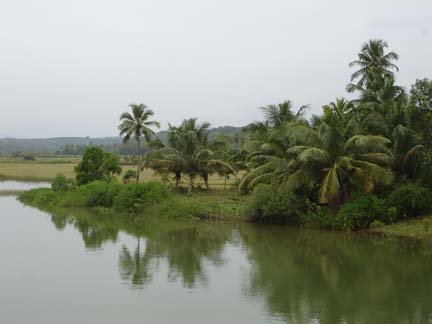
Holegadde near Honavar,Uttara Kannada dist, Karnataka
Copy? Right - but kindly remember to acknowledge!

" tulu-research.blogspot." ತುಳು ರಿಸರ್ಚ್. ಬ್ಲಾಗ್ಸ್ಪಾಟ್. ಇನ್

Have a nice day !