Mundkur Durga Parameshwari temple celebrates annual car festival this year on 18th February 2010.
A friendly comment by M.A. Acharya, on an earlier rather hastily written post on ‘MunDkūr’ prompts me to add some additional data on the obscure history of this place:
Mundkur [pronounced ‘MunDukoor’] is a large village that can be met on the way from Murukaveri to Belman. Murukaveri is a place name derived from ‘three ‘kayar’. It can be reached either from Kinnigoli or Kateel. Inna hamlet that can be accessed from the Padubidri -Karkal main road constitutes northern part of the Mundkur village.
River Shāmbavi
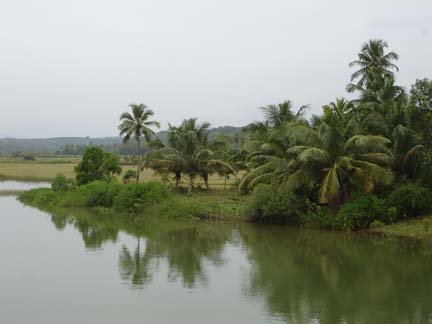
Mundkur village is located on the bank of River Shāmbavi. River Shāmbavi originates near Saānur and flows westward and meets the Arabian Sea near Mulki town. Hence it is also known as Mulki River. Interestingly, it takes an unusual rectangular U shaped bend south of Mundkur village. This unusual shaped fluvial path has been induced by tectonic movements in the Earth surface.
Origin of the name of the river is not clear. It appears that the name ‘Shāmbavi’ is a variant of ‘Jāmbavi’ the female counterpart of ‘Jāmbava’. The name ‘Jāmbava’ is a Tulu form of ‘Jāmbavantha’, a bear character associated with Sugriva in Ramayana. A bear spirit named Jumādi (or ‘Doomavathi’) is being worshipped in Tulunadu. Thus, the River Shāmbavi has possibly been named after the ancient spirit of the region, Jumādi.
It may be recalled that a river flowing in Kundapur Taluk has been named Varāhi, possibly after the cult of Panjurli, the ancient spirit of a wild boar.
The name Shāmbavi has been considered as an incarnation of Goddess Shakti, but there are no known temples dedicated to the worship of Shāmbavi in the region.
Place-name: Mundkur
The place name Mundkur (munD+kur) has been attributed to one demon called Mundāsura, who was exterminated by Goddess Durga Parameshwari according to the Puranic lores. Apart from this, the place name carries significant vestiges of the early history of Tulunadu. The ancient words ‘mund’ and ‘munDa’ have remained in our vocabulary as a fossils providing evidence to the notion that tribes belonging to Toda and Munda group survived in these region in the past.
Toda mund
The word ‘mund’ represents a hamlet in Toda language. And the word ‘munda’ represents ‘village headman’ in Munda group of languages. The word ‘munda’ (=young man) has also survived in languages like Punjabi.
Toda tribes now live in Niligiri are a hilly tracts of Tamilnadu. It is said they migrated to southern India from the north. Toda tribes used to follow polyandry like Tibetans. Polyandry was followed among certain tribal communities in the past. Mahabharata has documented polyandry among Pandavas, with Draupati being married to five Pandava brothers. Toda were traditionally dairy farmers, closely associated buffaloes and activities. They traditionally live in huts with semicircular to conical roof sloping in either directions.
It appears that Toda tribes lived in Mundkur and Kallamundkur region in the past. There is also another village in the neighborhood known as ‘Todar’, near Mudabidri, distinctly named after Toda tribes.
Toda-Munda
Robert Caldwell and succeeding linguists have classified the language of Toda tribes under Dravidian Group of languages. However, the basic Toda word for house, ‘mund’ and its relation to the word ‘munda’ suggests connection with Munda group. It is possible that some of the tribes and their languages now linguistically classified under Dravidian were formerly members of the older Munda group of langauges.
Mundala tribe
There are several places in the West coast that carry Munda tags such as Mundadi, Mundaje, Mundugodu, Kallamundkur, Hermunde, etc. The ‘Mundāla’ tribes of the Karavali - Tulunadu are the surviving members of the ancient Munda tribes that pervaded large parts of the southern peninsula once upon a time in the antiquity. The Munda Group of Austro-asiatic tribes, are now distributed in parts of Central India like Orissa, Jharkand, Chattisgarh, Madhya Pradesh, apparently were spread all over southern India in the antiquity. Their languages have not been studied in detail. And it is possible that some of the languages presently classified under the Dravidian Group may might actually be evolved remnants of the older Munda group of languages.
Kallamundkur village is located to the south of Mundkur, separated by River Shāmbavi. Apparently, the southern Kalla-mundkur was distinguished from northern Mundkur at a later time. The ‘ kalla’ prefix in Kallamundkur probably refers to the rocky (‘kallu’=stone) outcrops in the area rather than to the kallar/ kannar or kalavar tribes.
‘Kotrupadi’ area, reminiscent of ancient ‘Kotru’ or ‘Koitur’ Gonda tribes , is a hamlet in the northern part of Kallamundkur.
Spatial suffix –kūr
The spatial suffix ‘-kūr’(or -koor) is less common in Tulunadu. It appears it developed as ‘ku’+’oor’ (= good +village). Apart from Mundkūr, we have Nandikūr village towards north. Nandi represents bull.
Some people believe that the name of Bārkūr, a major historical city of Tulunadu was derived from the words ‘bār+kūr’, where bār means paddy. However, analogy of similar place names duplicating along the West coast (such as Kalyana, Uchila, Pandeshwara, Bārke, etc) suggest that Barkur was Barka + oor. Historical reports of Ptolemy ( ca. 150 BC) for example refer to the Gulf of Cutch as Gulf of Baraka. Similarly, the Barkur during the early historical period was located in the gulf or estuary of Seetha and Swarna rivers. The combined river mouth of Seetha -Swarna has been altered during subsequent history. Besides, the estuary of Kudroli -Bokkapatna was known as ‘Barke’. The name Barke near Bokkapatna, Mangalore still exists.
Bellar: White tribes
One of the interesting features in the ancient history of Tulunadu is the documentation of arrival and settling of white races. There is a distinct set of villages carrying names of ‘Bel ‘or ‘Bellar’ (kannada) and ‘’ or ‘Bollar’(Tulu).
Tulunadu There are several villages around Mundkur that carry the names of Bella/Bolla/Vella (=white) tribes. Originally the southern India was a habitat of dark skinned tribes. Fair or white skinned tribes immigrated into these areas at a later period in the history. Village names Belman, Bola, Beluvayi, Balkunje (originally this village might have been known as ‘Belkunje’) and probably also ‘Inna’ suggest the invasion of white skinned tribes. These villages are located on the either periphery of Toda-Munda villages and probably there were historical clashes between the Toda Mundas and Bella tribes, possibly during the early centuries of the Common Era. The clashes have been glorified and reflected in the theme of Devi Mahatme.
Inna
Inna is also a strange name without any appropriate meaning in the native languages. It is possible that ‘Inna’ represents an immigrant tribe from Caucasian/Russian region. Possibly the villages with ‘kencha-‘ (=reddish) prefix also refer to such reddish tanned European immigrated into these areas during the early history.
Gururaja Bhat (2009 edition) has cited the presence of Bellar tribes in Tulunadu and other parts of southern India. He opined that they existed during the Rigveda period. Therefore it may be tentatively proposed that ‘Bellar’ white skinned immigrants entered southern India during the period ca.1200-800 BC.
 Durga Parameshwari
The idol of Mundkur Durgadevi temple has been identified as Mahisha Mardini. Durga Devi is known as Durga Parameshwari in the region suggesting supremacy of Shakti cult. (‘Parameshwari’= parama + eshwari=supreme goddess).The idol in the Durga temple is 75cm in height with slim body holding conch (‘shanka’) and wheel (‘chakra’) in upper hands. It has a small crown on the head. The lower left hand is carved showing the act of seizing the tail of ‘Mahisha’ (the buffalo demon)and the lower right hand holds the trident-spear (‘trishula’) vertically slaying the Mahisha.
Based on the sculptural style, the idol has been dated at 6th Century CE. (Murulidhara Upadhya & Narasimha Murthy, 2000).
Mahisha Mardini
Several versions of “Devi Mahatme” puranas, describing the prowess of the goddess Durga Devi are in vogue. Historians believe that the Bhagavathi cult during the waning stages of Buddhism in southern India , probably under the influence of Hindu revivalist sages like Shankaracharya later developed into Durga worship cults in Kerala and Tulunadu. Devi Mahatme envisages several villainous Asura characters like like Chanda, Munda and Mahisha, who were ultimately slained by the Goddess Durga. She acquired the name ‘Mahisha Mardhini’ (mahisha=buffalo, mardhini=slayer) after slaying the Mahisha-asura. ‘Mundkur kshetra Mahatme’, a variant of ‘Devi Mahatme’ envisages that the place name Mundakūr came into being, consequent upon Goddess Durga killing the Asura Munda.
Infact, Asura tribes were one of the members of Munda tribes. Ancient tribes like Munda and Toda , being dairy farmers, held ‘mahisha ‘(=buffalo) in respect. Or in other words, the dairy animal buffalo was representative of the Todas and Mundas.
It appears that the entire concept ‘Devi Mahatme’ (ca. 6 century CE) consisting of extermination of the buffalo- demon (‘Mahishasura’) was probably built on the theme of driving off Toda tribes from the region. Buffaloes were integral part of Toda culture. The ‘Asura’ were also a sub-sect of Munda tribes. And the cult of ‘Mahisha Asura’ probably depicted the villainous elements among the Toda Munda tribes that clashed with Bellar tribes over various socio-political issues, before being driven out of the area.
Todas tribes possibly had evacuated the region (ca. 1-3 century CE) before the creation of the legend. And Mundkur region might have been the original site where the concept poetic theme of buffalo slayer ‘Mahisha Mardini’ in Devi Mahatme was conceived.
The West face: Vāstu
Originally the main entrance to the temple and the idol was built and installed facing towards the West facing the proximal segment of the Shāmbavi River. An old ‘kalyani’ (temple pond) still exists on the Western boundary of the temple, providing substantial evidence to this fact. Later the main entrance and the idol were changed to face the East direction. This appears to be the result of a major shift in the architectural (Vāstu ) concept during this period. The main entrance of many old Shiva/ Durga temples of Karavali like Sharavu (Mangalore), Chitrapura, Bappanadu etc still face Western direction. It is a Vastu concept that the devotee should face eastern direction while praying to the God.This concept might have been initiated on account of Sun worship wherein the devotee to faces Sun in the East direction. Therefore,in the Vastu concept, to enable the devotees to pray towards east the idol and the main entrance are to be placed facing west.
Somehow this concept underwent changes apparently during the eminence of Natha cult.Thus, Mangaladevi temple, Mangalore, has been built with idol and main entrance facing towards East. The Kadri Shiva temple faces north,but the main entrance to the temple premise faces East. Thus, it seems the periodical changes in the Vastu concepts,during the history, prompted alteration in the direction of idol and entrance in the Mundkur Durga temple.
®