In a previous post on the legend of Rama, inference was that Ramayana was composed and built around a folk-lore on a tribal hero, specifically a Bhil archer. The hero of the epic, the Rama as well as the compiler of the epic, Valmiki both hailed from the ancient Bhil archer community.
It is generally believed that the name ‘Rama’ is a Sanskrit word. However, the available clues show that the name ‘Rama’or ‘Ram’ also may have been borrowed from the ancient/pre-Sanskrit folklores.
A research paper by Malini Srivastava (2007) on Munda culture and customs describes some interesting Munda customs and festivals. Munda tribes celebrate an annual festival called ‘Karam’. The origin of the ‘Karam’ festival is explained as a simple story that is quite interesting.
There were two brothers known as ‘Karam’ and ‘Dharam’. Dharam did not work whereas Karam worked hard in the agricultural fields, got good crops and became rich. Munda tribes celebrate the victory of Karam over Dharam in the form of a festival called ‘Karam’!
Karam and Dharam
The origin of the ancient ‘Karam’ festival shows some new insight into the nature of Early Munda words. As it is obvious from the story, ‘Karam’ means action or work, whereas ‘Dharam’ stands for philosophy. The ancient Munda anecdote reinstates the evergreen wisdom that work is worship.
These same words Karam and Dharam have subsequently been taken into Sanskrit and, may be, all present Indian languages. Now, both the words have detailed shades of meaning far more complex than the original simple connotations.
Karam-Kadamba
Karam in Munda language also represented a tree called ‘Karam’ or ‘Kaim’. Later this tree was known as Kadamba tree. The Kadamaba tree must have been quite auspicious since early historical days. The royal clan founded by Mayura Sharma at Banavasi (5th century AD) designated themselves as Kadamba dynasty.
Karam is the festival of victory of the farmer (agriculturist), celebrated on the eleventh moon day of the month ‘bhado’(September). A twig of ‘Karam’ (Kadamba) tree is brought and worshipped in the courtyard of the house. Later on the day, young shoots (‘ears’) of grain are distributed among friends and relatives.
This festive custom has been adopted by Tulu people in ‘Posatt’ (‘new crop’ festivity) or the ‘Koral parba’. The impact of the ‘koral parba’ on the regional populace is so deep that it is also celebrated by local Christians, converted from Hinduism. ‘Onam’ (Kerala) and ‘Huttari ‘(Kodagu) are regional variants of this festival.
Ram-Rama
The byproduct of the story is that if ‘Karam’ and ‘Dharam’ are antique words from Munda/Bhil languages, then the word Ram also was derived from the same source.
The existence of ancient Munda personal names like Karam and Dharam suggests that there may have been personal name like Ram or Rama.
®

A heritage blog by: Ravindra Mundkur & Hosabettu Vishwanatha
Thursday, December 20, 2007


Saturday, December 15, 2007
59. The less evolved ancient tribes

Some of the Early tribes resisted development and remained in forest phase or hunter-gatherer phase for a prolong time, leading to gaping socio-cultural differences between the evolved and the poorly evolved. These less evolved tribes constitute the scheduled castes and scheduled tribes of present generation.
The District Gazetteer of South Kanara (1973) enlists the following scheduled castes and tribes in Dakshina Kannada (formerly South Canara).
The scheduled castes: (1) AdiAndhra, (2) AdiDravida, (3) AdiKarnataka, (4) Ajila, (5) Arunthathiyar, (6) Baira, (7) Bakuda, (8) Bandi, (9) Bellara/i (10) Chakkaliyan, (11) Chalavadi, (12). Chamar (Muchi), (13) Chandala, (14) Cheruman, (15) Devendra, (16) Kulathan , (17) Godagali, (18) Godda, (19) Gosangi , (20) Holeya , (21) Jaggali, (22) Jambuvulu, (23) Kadaiyan, (24) Kalldi, (25) Karimpalan, (26 ) Koosa, (27) Kuduban, (28) Kuruvan, (29) Madrai, (30) Madiga, (31) Maila, (32)Mala, (33) Mavilan (34) Moger, (35) Mundala, (36) Nalke, (37) Nayadi, (38) Pagadi, (39) Pallan, (40) Pamabada, (41) Panchama, (42) Pannaiandi, (43) Paraiyan, (44) Puthinai Vannan, (45) Rancyar, (46) Samagar, (47) Sambai (48) Sapayi (49) Seman (50) Thoti (51) Tiruvalluvar, (52) Valluven , ( 53) Bathada, (54) Hasti , (55) Paravan.
The following are the scheduled tribes enlisted:
(1)Adiyan, (2) Aranadan (3) Irular (4) Kadar (5) Kammara (6) Kattunayakan (7) Konda kapu (8 ) Konda reddis (9) Koraga (10) Kota (11) Kudiya/ Malekudiya (12 ) Kurichchan (13 ) Kuruman (14) Mahamalasar (15) Malasar (16) Maleya kandi (17 ) Maranthi (18) Mudugar (19) Palliyan (20) Paniyan (21) Pulavan (22) Shologa (23) Toda .
Similar list of tribes exist in the neighbouring Kerala also.( Madhava Menon et al (2002) People of India : Kerala : Volume XXVII.Anthropological Survey of India)
Notes on Early Tribes/languages
1. The ‘Koosa’ tribe may be ‘Kosar’ tribes of Karavali described in the Tamil Sangam literature.
2. The Karavali ‘Bakuda’ and 'Bathuda' tribes may be equivalent/variants of ‘Bathudi’ tribe of Chotanagpur.
3. The ‘Bellari’ language, originally might have been a variant of the Munda language, but apparently changed with time by induction of Tulu words and was later considered as a variant of Tulu rather than Munda.(Refer Manjunath’s post on Bellari). There are several places in Karavali and Karnataka mainland having names such as ‘Bellara’ or ‘Bellari’.
4. Several tribal/sub-language names have remained as place names. These ancient cultural vestiges include Bellara/Bellari, Parenki, Gadaba (Kadaba), Kharawar, etc.
5. Many place names with unknown or unexplainable meanings in the current languages in Karavali and other parts of Karnataka/southern India may have been inherited from the Early Munda substratum language and culture that existed earlier.
The native Early Munda languages prevalent in southern India before ca.800-600BC, appear to have merged with the Early Dravidian and Early Tulu languages. The vestiges of these native languages in southern India are on the way to gradual extinction due to overprinting impact of cultural changes.
®
58. Evolution of Early communities
Archeological researches have unearthed evidences for the primitive agricultural communities in the river valleys of south India. Similar agricultural-cattle breeding communities existed in Karavali also, though detailed data are not available. However, the sporadic evidences of relics such as megalithic burial structures (‘Sasindiri’ at Pandavara kallu, near Madyanthar, Belthangadi taluk) suggest that ancient Munda tribal settlements existed in the Karavali.
The Karavali being a zone of intense rainfall and sea-level fluctuations, many of the delicate archeological evidences might have been washed away or obliterated due to the impact of the natural hazards. Further, systematic searches may yield invaluable new archeological data.
Early Munda Groups
The early agricultural-pastoral communities that pervaded before the arrival of early Tulu/ Dravidian immigrants into southern India evolved into elaborate subgroups and communities in India. The word ‘Munda’ means headman of a village. Presently in the Chotanagapur area, several Munda tribes and languages have survived.
Some of the Munda languages that exist presently in India (in parts of Chotanagapur (Jharkhand), Chattisgarh, Bengal, Orissa and Andhra Pradesh) and Bangladesh are:
Agariya, Bijori, Korku, Mavasi, Mundari, Bhumji, Asuri, Koda, Ho, Birhor, Santali, Mahali, Turi, Kharia, Juang, Gata, Bondo, Bodo Gadaba, Parengi, Sora, Koraput, Korba, Bidaho, Kurmali,Nagesia, Sounta (Toori),Majhi, Majhwar etc. Some of these tribes are called Asur, Baiga, Banjara, Bathudi, Bedia, Birhor, Bhumij, Karmali, Kharwar, Lohra etc. Many of these tribes and their dialects are on the verge of extinction. Similarly there are Bhil tribes have survived in the western and central parts of India.
Early Munda tribes in Karavali
Anthropological socio-cultural evolution proceeded from primitive phase to hunter-gatherer stage to pastoral (cattle-breeding) and agricultural stages. This evolution, however, was not an en masse progressive transformation; it progressed in batches and there could be phases of reversals. It may be visualized that a part of hunters adopted themselves to farming and agriculture, while many others remained in the hunter/gatherer or still primitive stages.
Bhil/Billava
Primitive hunters devised tools stone axes to begin with and further developed bows and arrows. The specialists who were able to use the bow and arrows (the archers) were called ‘bhils’ (bhil=bow) in central and northern India; similar tribes in Karavali were called ‘billavas. The mark in the timeline was ca.5000-4000 BC.
The core story of the original Ramayana was built around the legend of a bhil/billava (archer) called Ram or Rama. It was popular for ages among the early cultures in the form of folk-lore or pad-dana. Later, ca. 500 BC, the folk-lore story was retold by another bhil called ‘Valia’ (the sage Valmiki) in the form an elaborate epic, with ample elements of fantasy thrown in to increase the mass appeal of the story.
Mogera Fisherfolk
The Karavali, with mighty Arabian Sea and many of rivers, hosts enormous fishery wealth. A section of hunter-gatherer tribes evolved the art of marine and inland fishing. They lived collectively in fishing community villages that were later called ‘pattana’(=towns). They had group leaders called ‘gurikara’ or ‘gurkara’. The custom of having community leaders who take judgments and decisions on behalf of the group is a common feature of surviving Munda tribes even today.
Bhumiputra/Okkelme
The native farmer is called ‘Okkelme’ and the group was called ‘Okkelakulu’in Tulu language. ‘Bhumij’ is a farming tribe among Mundas. In ‘Tuluvala Baliyendra’ (the Tulu version of Baliyendra folklore) the legendary Bali is referred to as ‘bhumiputra’. Note analogy between the words ‘bhumij’ and ‘bhumiputra’. The time of initiation of agriculture in Karnataka according to archeological data is ca.3000-2800 BC.
The Karavali being a zone of intense rainfall and sea-level fluctuations, many of the delicate archeological evidences might have been washed away or obliterated due to the impact of the natural hazards. Further, systematic searches may yield invaluable new archeological data.
Early Munda Groups
The early agricultural-pastoral communities that pervaded before the arrival of early Tulu/ Dravidian immigrants into southern India evolved into elaborate subgroups and communities in India. The word ‘Munda’ means headman of a village. Presently in the Chotanagapur area, several Munda tribes and languages have survived.
Some of the Munda languages that exist presently in India (in parts of Chotanagapur (Jharkhand), Chattisgarh, Bengal, Orissa and Andhra Pradesh) and Bangladesh are:
Agariya, Bijori, Korku, Mavasi, Mundari, Bhumji, Asuri, Koda, Ho, Birhor, Santali, Mahali, Turi, Kharia, Juang, Gata, Bondo, Bodo Gadaba, Parengi, Sora, Koraput, Korba, Bidaho, Kurmali,Nagesia, Sounta (Toori),Majhi, Majhwar etc. Some of these tribes are called Asur, Baiga, Banjara, Bathudi, Bedia, Birhor, Bhumij, Karmali, Kharwar, Lohra etc. Many of these tribes and their dialects are on the verge of extinction. Similarly there are Bhil tribes have survived in the western and central parts of India.
Early Munda tribes in Karavali
Anthropological socio-cultural evolution proceeded from primitive phase to hunter-gatherer stage to pastoral (cattle-breeding) and agricultural stages. This evolution, however, was not an en masse progressive transformation; it progressed in batches and there could be phases of reversals. It may be visualized that a part of hunters adopted themselves to farming and agriculture, while many others remained in the hunter/gatherer or still primitive stages.
Bhil/Billava
Primitive hunters devised tools stone axes to begin with and further developed bows and arrows. The specialists who were able to use the bow and arrows (the archers) were called ‘bhils’ (bhil=bow) in central and northern India; similar tribes in Karavali were called ‘billavas. The mark in the timeline was ca.5000-4000 BC.
The core story of the original Ramayana was built around the legend of a bhil/billava (archer) called Ram or Rama. It was popular for ages among the early cultures in the form of folk-lore or pad-dana. Later, ca. 500 BC, the folk-lore story was retold by another bhil called ‘Valia’ (the sage Valmiki) in the form an elaborate epic, with ample elements of fantasy thrown in to increase the mass appeal of the story.
Mogera Fisherfolk
The Karavali, with mighty Arabian Sea and many of rivers, hosts enormous fishery wealth. A section of hunter-gatherer tribes evolved the art of marine and inland fishing. They lived collectively in fishing community villages that were later called ‘pattana’(=towns). They had group leaders called ‘gurikara’ or ‘gurkara’. The custom of having community leaders who take judgments and decisions on behalf of the group is a common feature of surviving Munda tribes even today.
Bhumiputra/Okkelme
The native farmer is called ‘Okkelme’ and the group was called ‘Okkelakulu’in Tulu language. ‘Bhumij’ is a farming tribe among Mundas. In ‘Tuluvala Baliyendra’ (the Tulu version of Baliyendra folklore) the legendary Bali is referred to as ‘bhumiputra’. Note analogy between the words ‘bhumij’ and ‘bhumiputra’. The time of initiation of agriculture in Karnataka according to archeological data is ca.3000-2800 BC.
Wednesday, December 12, 2007

Tuesday, December 11, 2007
57. A word that travelled : Ayana
The word ‘Ayana’ is used in several contexts in many Indian words, such as Ram-ayana, Nar-ayana, Satya-nara-ayana, Uttar-ayana, Dakshin-ayana, S-ayana, Nir-ayana etc.
Besides in Indian languages it is also found in several African –Mediterranean languages. A perusal of the meaning of the word ‘ayana’ in different languages helps tounderstand its antiquity and the range of meanings it conveys. A site www.sarbadhikari.com/ayan/ayanmng.htm lists some of the many shades of the meanings the word ayana carries in diverse languages across the world.
Sanskrit: The marching in; The path, The path of suns travel in the sky; The solstice; The shift in the path; Soaked in divine glory; The speed; The mirror; The name of Radha’s husband ‘Ayana Ghosa’,(Radha in the Krishna legend).
Tamil: The creator, the Brahma.
Tulu: The annual festival in ancient temples; the celebration;half year; a pronoun denoting 'belonging to him'.
African: The central part of the soul.
Nigeria: The drum beats; Spirit within the drum.
Somalia: The bright (feminine name).The lucky one.
Egypt: The division between two lands or worlds.
Persian: The clear one; Obvious; Notable.
Turkish: The obvious.
Hebrew: The Peace.
Arabic: God’s gift.
English (Bible): To arrive.
Besides in Indian languages it is also found in several African –Mediterranean languages. A perusal of the meaning of the word ‘ayana’ in different languages helps tounderstand its antiquity and the range of meanings it conveys. A site www.sarbadhikari.com/ayan/ayanmng.htm lists some of the many shades of the meanings the word ayana carries in diverse languages across the world.
Sanskrit: The marching in; The path, The path of suns travel in the sky; The solstice; The shift in the path; Soaked in divine glory; The speed; The mirror; The name of Radha’s husband ‘Ayana Ghosa’,(Radha in the Krishna legend).
Tamil: The creator, the Brahma.
Tulu: The annual festival in ancient temples; the celebration;half year; a pronoun denoting 'belonging to him'.
African: The central part of the soul.
Nigeria: The drum beats; Spirit within the drum.
Somalia: The bright (feminine name).The lucky one.
Egypt: The division between two lands or worlds.
Persian: The clear one; Obvious; Notable.
Turkish: The obvious.
Hebrew: The Peace.
Arabic: God’s gift.
English (Bible): To arrive.
Sunday, December 9, 2007
56. Assimilation of Indo –Aryans
The Indo-Aryan invasion hypothesis needs to be mended and modified in the light of recent scientific data! The fact is that Indo-Aryan immigrants did not invaded India as proposed earlier. The number of Indo-Aryans who immigrated was quite few.
The Y-chromosomal genetic data compiled by Sanghamitra Sahoo et al (2006) suggested a minor influx, of people of the Indo-Aryan language family from regions north and west of India. The Vedas were composed a group (about a dozen in number) of sages. With time the Vedic sages apparently had marital relations with natives and were gradually absorbed and assimilated into the pre-existing lingo-cultural fabric of India.
S. Sharma et al. (2007) in their recent paper (“The Autochthonous Origin and a Tribal Link of Indian Brahmins: Evaluation Through Molecular Genetic Markers “- abstract-cited in Dienekes anthropological blog) reported as follows:
“..we screened 621 Y-chromosomes (of Brahmins, Dalits and Tribals) with fifty-five Y-chromosomal binary markers and Y-microsatellite markers and compiled a data set of 2809 Y-chromosomes (681 Brahmins, 2128 Tribals and Dalits) for conclusions. Overall, no consistent difference was observed in Y-haplogroups distribution between Brahmins, Dalits and Tribals, except for some differences confined to a given geographical region.
A peculiar observation of highest frequency (upto 72.22%) of Y-haplogroups R1a1* in Brahmins, hinted at its presence as a founder lineage for this caste group. The widespread distribution and high frequency across Eurasia and Central Asia of R1a1* as well as scanty representation of its ancestral (R*, R1* and R1a*) and derived lineages across the region has kept the origin of this haplogroup unresolved. The analyses of a pooled dataset of 530 Indians, 224 Pakistanis and 276 Central Asians and Eurasians, bearing R1a1* haplogroup resolved the controversy of origin of R1a1*.
The conclusion was drawn on the basis of: i) presence of this haplogroup in many of the tribal populations such as, Saharia (present study) and Chenchu tribe in high frequency, ii) the highest ever reported presence of R1a* (ancestral haplogroup of R1a1*) in Kashmiri Pandits (Brahmins) and Saharia tribe, and iii) associated averaged phylogenetic ages of R1a* (~18,478 years) and R1a1* (~13,768 years) in India. The study supported the autochthonous origin of R1a1 lineage and a tribal link to Indian Brahmins.”
Brahmin-ization
The cited genetic study suggests that the native Indian tribes evolved in the land since 11 to 16 thousand years BC. The study also points to brahmin-ization of native tribes. And this could have happened ca.800-600BC, the magic period when Indo-Aryans and Early Dravidians entered the Indian mainland from the northwest. The Vedas were composed by a group of Indo-Aryan immigrants to NW Indian subcontinent ca 1900 to 800 BC. The Indo-Aryan immigrants were few in number as they immigrated into the Indian mainland and they gradually culturally assimilated with the natives. Select natives must have been absorbed into Vedic schools and were educated in Sanskrit.
The native tribes had evolved pockets of well developed religions and cultures. Some of them joined the Vedic tradition and contributed their talents in composing the great Puranas and Epics of India. Many examples exist in the legends in support of this theory. Valmiki who compiled and composed Ramayan was a bhil, a native archer. Sage Agasthya was a former washer-man (dhobi) from the fold of natives. Jabali was originally from the native tribes. Vedavyasa, the famed dark-skinned (‘Krishna’ Dwaipayana) and talented composer of Mahabharata was born to a woman of lower caste.
Therefore the Early Indian caste system (500-300 BC) was created out of the evolved fraction of native groups.
®.
The Y-chromosomal genetic data compiled by Sanghamitra Sahoo et al (2006) suggested a minor influx, of people of the Indo-Aryan language family from regions north and west of India. The Vedas were composed a group (about a dozen in number) of sages. With time the Vedic sages apparently had marital relations with natives and were gradually absorbed and assimilated into the pre-existing lingo-cultural fabric of India.
S. Sharma et al. (2007) in their recent paper (“The Autochthonous Origin and a Tribal Link of Indian Brahmins: Evaluation Through Molecular Genetic Markers “- abstract-cited in Dienekes anthropological blog) reported as follows:
“..we screened 621 Y-chromosomes (of Brahmins, Dalits and Tribals) with fifty-five Y-chromosomal binary markers and Y-microsatellite markers and compiled a data set of 2809 Y-chromosomes (681 Brahmins, 2128 Tribals and Dalits) for conclusions. Overall, no consistent difference was observed in Y-haplogroups distribution between Brahmins, Dalits and Tribals, except for some differences confined to a given geographical region.
A peculiar observation of highest frequency (upto 72.22%) of Y-haplogroups R1a1* in Brahmins, hinted at its presence as a founder lineage for this caste group. The widespread distribution and high frequency across Eurasia and Central Asia of R1a1* as well as scanty representation of its ancestral (R*, R1* and R1a*) and derived lineages across the region has kept the origin of this haplogroup unresolved. The analyses of a pooled dataset of 530 Indians, 224 Pakistanis and 276 Central Asians and Eurasians, bearing R1a1* haplogroup resolved the controversy of origin of R1a1*.
The conclusion was drawn on the basis of: i) presence of this haplogroup in many of the tribal populations such as, Saharia (present study) and Chenchu tribe in high frequency, ii) the highest ever reported presence of R1a* (ancestral haplogroup of R1a1*) in Kashmiri Pandits (Brahmins) and Saharia tribe, and iii) associated averaged phylogenetic ages of R1a* (~18,478 years) and R1a1* (~13,768 years) in India. The study supported the autochthonous origin of R1a1 lineage and a tribal link to Indian Brahmins.”
Brahmin-ization
The cited genetic study suggests that the native Indian tribes evolved in the land since 11 to 16 thousand years BC. The study also points to brahmin-ization of native tribes. And this could have happened ca.800-600BC, the magic period when Indo-Aryans and Early Dravidians entered the Indian mainland from the northwest. The Vedas were composed by a group of Indo-Aryan immigrants to NW Indian subcontinent ca 1900 to 800 BC. The Indo-Aryan immigrants were few in number as they immigrated into the Indian mainland and they gradually culturally assimilated with the natives. Select natives must have been absorbed into Vedic schools and were educated in Sanskrit.
The native tribes had evolved pockets of well developed religions and cultures. Some of them joined the Vedic tradition and contributed their talents in composing the great Puranas and Epics of India. Many examples exist in the legends in support of this theory. Valmiki who compiled and composed Ramayan was a bhil, a native archer. Sage Agasthya was a former washer-man (dhobi) from the fold of natives. Jabali was originally from the native tribes. Vedavyasa, the famed dark-skinned (‘Krishna’ Dwaipayana) and talented composer of Mahabharata was born to a woman of lower caste.
Therefore the Early Indian caste system (500-300 BC) was created out of the evolved fraction of native groups.
®.
Friday, December 7, 2007
Nature-scape of Tulunadu 1

Gundya: foothills of Sahyadri
A charming nature-scape to break the monotony of textual posts.An image captured along the Subramanya-Gundya road.
Subscribe to:
Posts (Atom)
A Coastal estuary
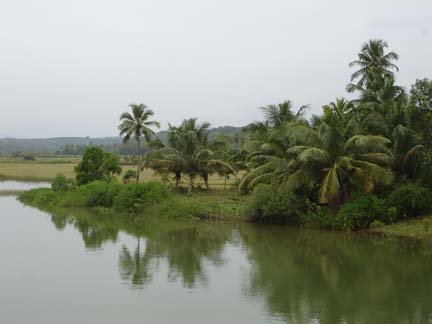
Holegadde near Honavar,Uttara Kannada dist, Karnataka
Copy? Right - but kindly remember to acknowledge!

" tulu-research.blogspot." ತುಳು ರಿಸರ್ಚ್. ಬ್ಲಾಗ್ಸ್ಪಾಟ್. ಇನ್

Have a nice day !