Migrating tribes in the antiquity, who set out on a long trail from Africa to India, obviously with several periodic stops in between, have brought in many antique words along with them. Tulu, Bantu, Siri, Sira, Kola etc are some of the common words deduced in these blog pages to have been brought from Africa to India.
The place name ‘Manki ‘ appears t have been introduce into Karavali in the similar way, either from Papua New Guinea or from the side of Northwestern region of Indian subcontinent as discussed in the previous post.
Kenya-Kinya
One more such place name that is found in Africa as well as in Tulunadu is the word Kenya or Kinya. Kenya is a State in Africa. Kenya means the abode of Gods in African language.
We have similar sounding two places in Tulunadu that bear the name of Kinya and Kenya. In southern part of Mangalore taluk, there is one village called ‘Kinya’. And in northern part of Sullia taluk is another village called ‘Kenya’. Both these place names could be the variants of a single name Kenya. It may be recalled that the region Kenya in Africa is also pronounced as Kinya.
In the Tulu language we can somehow find meanings for both these names, but it would be neither logical nor appropriate. The word ‘Kinya’ means smaller in present Tulu. However, this meaning appears inappropriate and may not be the original meaning of the place name. Similarly, word ‘Kenya’ means ‘listen to me’ in Tulu which again is inappropriate, if not absurd, as a place name. Besides, we have analyzed in previous posts that -ya or –ia are the spatial prefixes/suffixes with (divine connotations) not only in Tulunadu (eg. Aikala, Murulia, Sullia etc) but also in Africa and Asia and Asia Minor (Arabia, Namibia, Kenya, Tunisia, Ethiopia etc).
Therefore since, -ya is a spatial suffix, Kinya and Kenya should be analyzed as
kin +ya and ken +ya.
However, the words kin and ken apparently do not have any logical meanings in present Tulu language. Therefore it is proposed that the mysterious spatial name ‘Kenya’ has been brought to Tulunadu along with immigrants in the historical past.
®

A heritage blog by: Ravindra Mundkur & Hosabettu Vishwanatha
Friday, December 18, 2009


Thursday, December 17, 2009
216. Permanki

Some of the village names sound funny and do not have ready meanings even among the natives of those villages. One such hamlet name is Per(a)manki, located in Ulaibettu village on the banks of River Gurupur, near Neermarga and Mallur, in Mangalore Taluk.
The word ‘Permanki’ can be analyzed as follows:
In this place name, the Dravidian prefix ‘peru’ has been combined with ‘manki’. Peru or peri =large, big. Periya> hiriya= larger, bigger or elder. (There are several villages in Tulunadu carrying the prefix 'peru', like Pervaaje, Perankila, Perara, Perdur, Peramoger, Periadka, Peramannur etc.)
And we can attribute a meaning for the word ‘manki’ based on the line of analyses followed in earlier posts.
Manki= ma+anki= an elevated place.
Therefore, 'Permanki' stands for a large village located on a elevated ground or plateau.
Manki
The second word unit, namely Manki is an independent village name. We have a Manki village near Honnavar, Uttar Kannada district. The word ‘manki’ is a large settlement or a village in Munda cultural scenario and Munda language.
Suffix -ki
The word ‘manki’ emphasizes the existence of an ancient suffix -ki as a spatial attribute. It must be ancient one and discontinued later because it is not found in later or current Dravidian place names. However, it exists in some of the older place names like Neranki,Haleneranki,Parenki, Karenki(Dakshina Kannada),Karki, Valki (Uttara Kannada ), Bhalki (Bidar) etc.
Suffix –gi and –angi
Besides, we find another variant of suffix-ki in the form of –gi (or –angi) in Shimoga and surrounding regions. Ucchangi, Bhadrangi, Devangi, etc.Examples for places with suffix-'gi', are mostly found in Uttara Kannada and Uttar Karnataka: Balgi,Bargi,Biligi, Divgi, Byadagi, Nimbergi, Nesargi, Kalghatgi,Kushtagi, etc
Antiquity of words
The Karavali and contiguous parts of southern India have preserved many fossil words in the form of place names bearing testimony to numerous ancient tribes that sauntered and lived across this vast land. Although we find numerous fossil words as well as regional variants of some of these words, it is difficult task at this stage to pinpoint and classify the tribes and the words (languages) used by them.
Another possible way of establishing the antiquity of the words is to search for similar words (place names) in other parts of the world especially along known routes of human migration.
We find that Manki as a place name exists even in Swat region (North West Frontier Province), Pakistan, in the islands of Papua New Guinea and in Poland. The Gandhar region (present Pakistan and Afghanistan) have been known as one of the ancient routes of immigration into India. Similarly the Papua New Guinea has been described as one of the early centers of human civilization outside Africa.
The strings of data discussed above establish that ancient words such as ‘manki’ have been carried to different places by the migrating human tribes.
Manki stand
There is one 'Manki' stand near Mangaladevi Temple, Mangalore.In the absence Of proper explanation, some people might have thought of this as 'monkey stand'! Now, the name 'Manki'(=elevated area) tallies with the other alternate names existing for the Old Mangalore area such as 'Mangaar'(ma+ang+ar=elevated open field). The old name 'Mangar' for the area, later became 'Mangal' and 'Mangala'probably between 6th to 8th Century CE. Yet it is interesting to note that both the ancient place names, 'Mangaar' (near Yemmekere)and 'Manki'(near Mangaladevi temple) have survived.
-With Hosabettu Vishwanath
®
Monday, December 14, 2009
215. Manchakall

Do you remember a place called ‘Manchale’?
Manchale was the former name of the holy place later known as Mantralaya, located on the bank of River Tungabhadra in Raichur district, Karnataka. Guru Raghavendra, a Swami or sage of Madhwa cult became famous in the river side village of Manchale. The township and the religious institutions built around the brindavana (cemetery) of Raghavendra Swamy deserved a magical name and the old Manchale village was renamed as Mantralaya a few centuries ago. In the old village of Manchale, rural Goddess Manchalamma was a popular deity, a form of mother Goddess the local people believed in. The increasing influence of Raghavendra Swami overshadowed the popularity of the native Goddess Manchalamma, which was resented by many.
This year several Rivers of northern Karnataka were in spate owing to unprecedented heavy rainfall in the catchment area. River Tungabhadra was also flooded leading to submergence and severe damages to the properties of the religious institutions built in the name of Guru Raghavendra.
As the legend goes, Manchalamma was instrumental in Shri Raghavendra Swami locating his Ashram at Manchale. It is with the grace of Manchalamma he established the institutions. When he went to 'samadhi' state by interning himself in a Tulasi Vrindavana, he assured devotees that he would fullfil the wishes of 'Bhaktas' (devotees) by remaining invisible for 700 years (or so) thereafter. His power ,as experienced by devotees, is vibrant still today, though Manchalamma is the reigning deity of Manchale .>. Mantralaya.
However, the laymen connect the recent flooding at Mantralaya to the wrath or curse of Manchalamma for neglecting Her!
*
The place name Manchale= Mancha+ala. The suffix ‘ -ala ‘or ’- ale’ refers to the river. Then, what is the ‘mancha’?
Manchakall
Manchakall(u) is a hamlet adjoining Shirva town in Udupi district. Manchakall area is strewn with abundant rocky exposures. Manchakall sounds strange, but makes sense when you analyze the meanings of the place name Palli.
Palli also means ‘rock -bed’ structures used formerly by Buddhist and/or Jain monks during the early centuries of CE. Therefore, Manchakall is an alternate word for the Palli.
Mancha (=cot or bed) + kall (=rock).
Mancha in modern Kannada means a wooden cot. In Tulu, it also means pedestals or modified seats reserved for the installation of spirits. This application also indicates the possible heritage of the word. The rocky seat or pedestal preferred by monks was also known as ‘mancha’ or ‘manchavu’. Detailed archeological studies in the rocky region of Manchakall may throw special light on early historical rock structures frequented by Buddhist and or Jain monks. It is also possible that destruction of rocks in the name of development may have damaged any of the archeological structures.
Ma + anchav= elevated structure.
(Compare with:
‘manja’ . (ma +anja) =elevated land,
‘manga’ . (ma +anga) =animal on the tree.
'manji' . (ma +anji) = big sailing ship.)
Manchi
There is another similar sounding village in the southern part of Bantval Taluk that sports the name Manchi. The word ‘Manchi ‘was an early variant of the name ‘mancha’ or ‘manchav’. Several place names have such ‘–i ’ variants, such as nādu-nādi, pāda-pādi, vāda-vādi, bāda-bādi , uru- uri etc.
Besides there are many places all over Karnataka having the prefix of ‘mancha-’. The word mancha is a gift of Dravidian languages to Sanskrit. It is a widely used word in all languages, including Tulu. Vishwanath's Kannada Pandit in Vidyadayinee High School, Suratkal,late Shri Padmanabha Somayaji, who learnt Sanskrit for twelve years in Mysore, used to say that 'Mancha' is a Kannada word, gifted to Sanskrit.( For that matter, Tamils would say, that it is a gift from Tamil). Sanskrit has a definite rule for explaining etymology of a word from the root word. 'Mancha' is an exception to that rule.
Manchil: A palanquin used for carrying important persons in the past years. The Kula Gurus and religious pontiffs, were used to be carried around in such 'manchil's.
There are also Manchar in Tulunadu, Maharashtra, and Pakistan.
'Manchad' Manchad is a Tibeto-Burman language, also known as Pattani, Lahuli or Swangla, spoken in Hiamachal Pradesh
(Indo-Tibetan border) means a lower valley in local Tibetan dialect.
Manchar in Pune district is a town on Pune- Nashik road alongside Sahyadri Range. Manchar and Manchad are most probably cognates.
Rangamancha= A stage or (raised) platform for performing arts, like Yakshagana.
North Indians use the word ‘Manch’ to represent a platform, a stage or a forum.
-With Hosabettu Vishwanath.
®
Sunday, December 13, 2009
Vishwa Tulu Sammelano 2009


The festivities and the celebrations of the first World Tulu Conference (Vishwa Tulu Sammelano, 2009) comes to an end today 13th December 2009 at Ujire, Belthangadi taluk, Dakshina Kannada district.We have captured some of the scenes of the festivity brimming with enthusiasm and moods of the people.It is estimated that about 0.5 million people visited the conference.


The logo of 'Vishwa Tulu Sammelano 2009'.
Tuesday, December 8, 2009
214. PATNA
The word ‘patna’ represents a town in many of the Indian languages. The city in Jharkhand (and former capital of Bihar) is known as ‘Patna’. Besides, there are towns called ‘patna’ in Gujarat. In southern India, the word appears to have been applied to ancient port towns: Machalipatna, Nagapatna, Visakapatna etc. In Tulunadu context, the word is mostly applied to coastal colonies of Mogavir fishermen. In the olden days the fishing colonies were generally associated with port towns. Thus the word ‘patna’ was interchangeably used for port towns and the associated fishery colonies. People from the Tulu fishing community were used to be addressed as 'patnadakulu' (=fishermen) or 'pattaldi' (=fisher woman) by other communities.
On the other hand, the ancient towns and capitals were initially built around the port towns, as the ports were the major centers of trade and revenue.
Moolara patna
However, the word is not exclusively used for port towns or fishery colonies even in Tulu context. Moolara-patna on the bank of River Palghuni (Gurupur) is an example. Moolara patna as the name reveals is a colony of ‘Moola’ or ‘Moolya’ people. The word ‘moola’ represents origin and thus the word ‘moolya’ stands for aborigine.
Bokka patna
Bokka-patna is an example for an ancient port town associated with fishery colony. Bokkapatna is presently a lesser known civic extension in western part of Mangalore city. However, only few can visualize and realize that once it was a major port town representing Mangalore, especially during 12th to 15th Centuries CE. Reconstruction of geological history of the area reveals that the River Phalguni (Gurupur) was joining the Arabian Sea between Kudroli and Bolar. And the Kings of Vijayanagar who occupied Mangalore during 14th Century CE, developed port on the bank of river estuary and named it as “Bokkapatna” in honour of the Vijayanagar King Bukka (or Bokka).Therefore the Bokkapatna was the official Mangalore port during that historical period.
Patna: Let us analyze the word ‘patna’ ( pron: paTNa ) to gain some insights into the evolution of our words and languages. The origin of the word appears to be:
paTT + Na. (‘paTT’=colony or nest, aNa, aNe=area.)
There are at least four similar sounding roots related to the word patna: (1) patt 1(2) patt 2(3) pat, or pata and (4) pada and (5)padu.
1. Patt 1= a nest, a group or a colony.
2. Patt 2= to distribute among people.
3. Pata= a cloth, a curtain or a flag or a stretch of land. Also pictures, portraits or maps (drawn on a canvas, cloth piece or a paper) or a kite.. Examples: bhupata (=Map), chitrapata, galipata etc.
The Sanskrit word ‘path’(=linear path, road) appears to be related and /or derived from the old word ‘pata’
4. Pada=(pron: paDa) The word ‘paDa’ (pron: short pa+Da. Pa=low lying; Da=area) represents (1) a beach area demarcated for drying fish along the coast, or (2) a mat knitted from coconut fibers and used for drying fish. The word ‘paDa’ also means (3) to take a turn or (4) a large boat (‘paDavu’).
5. Padu =(pron: paDu) = West. (pa=(1).Sea margin, beach, (2) low lying; Du=area, possibly refers to the direction of Arabian Sea or coastal low lying area).
** **
There are some more related words for comparison in Tulu language:
Padil : PaDil represents a barren or waste land.
Patla: Patla (pron: paTla) means a low-lying marshy land alongside a river. [Origin: pa+T+la. ‘paT’=low lying +strip of land+ covered by ‘ala’(=water) ]. A ‘paTla kanDa’ means a wet, water-logged rice field, near a river, yielding only one crop per year In ‘patla kanda’, flooding is a common feature in rainy season rendering it unfit for rainy season's paddy cultivation of 'yenel' crop. ['Yenel' (yene+al) as ‘water from the sky’ (=rains)]. In these days of building constructions, these marshy lands are reclaimed and made habitable with modern type of buildings. Hence the Tulu idiomatic expression/usage: “Patla pOdu uru aanD” (=The marshy land has become village).
Patti: Patti (pron: paTTi) is a strip of cloth, metal or wood. It also developed into a linear strip like colony of houses or a village habitation.. The word ‘patti’(=habitation) became ‘hatti’ in medieval Kannada, with transformation of p> h.
Patti2 was a strip of cloth wherein records were written in the historical past, before the invention of paper.
Patta: The word ‘patta’ (pron: paTTa) means authority, throne or royal power. In other words it is power over a stretch of land.
Men of high positions (masters or authorities), landed gentry living in palatial buildings are called 'pattadakulu' in Tulu parlance.
Thus a ‘Patel’ represents a village chairman or head. The word ‘Patel’ has become ‘Pātil’ in northern Karnataka and Maharastra areas. Patel is also current in Gujarat as surname and profession. Possibly the word ‘Patel’ was brought to Tulu and Kannada region by the immigrants from north.
In interior Karnataka and Maharashtra, the word Patel has transformed to 'Patil or Pateela', meaning landlord, hence a man of high position.
Patte: The word ‘patte’ originally means a silken cloth. It was customary to preserve land records in a 'patte' (invariably in red colour). Hence, the word ‘patte’ it came to mean a 'registered land record', showing rightful entitlement. 'Patte kudtale' also means a record of ownership of land or landed property with registered right of paying land revenue tax. So the word: 'pattedār or pattadāre' (land-owner, possessing valid record of rights). 'Pattevaali' also means a striped silk cloth.
Patawari: Note this nomenclature current in Hindi-spaking belts. Meaning is similar to 'Patele, Patel, Pattedare, Pattadaare' (Tulu), Pātil (Maharashtra, Karnataka), Patel (Gujarat) and so on in other areas.
Patavardhan: This surname or title common in Maharashtra and Karnataka also relates to root word 'Pata'.
Pata Parivartan: meaning 'Change of flag,curtain', refers to change of circumstances in different points of time. In History, it means stages of different events, rise and fall of monarchies, governments, social and religious upheavals and new schools of thoughts.
Patasale (Padasale): Padsale means 'main living room of a house'. The word 'paDasale' possibly meant originally a west side living room.Kawdoor Narayana Shetty has pointed out that the word "saala" means a living room in Italian language.
Note: Pata and Pada are interchangeable words in Tulu.
-with Hosabettu Vishwanath.
®
On the other hand, the ancient towns and capitals were initially built around the port towns, as the ports were the major centers of trade and revenue.
Moolara patna
However, the word is not exclusively used for port towns or fishery colonies even in Tulu context. Moolara-patna on the bank of River Palghuni (Gurupur) is an example. Moolara patna as the name reveals is a colony of ‘Moola’ or ‘Moolya’ people. The word ‘moola’ represents origin and thus the word ‘moolya’ stands for aborigine.
Bokka patna
Bokka-patna is an example for an ancient port town associated with fishery colony. Bokkapatna is presently a lesser known civic extension in western part of Mangalore city. However, only few can visualize and realize that once it was a major port town representing Mangalore, especially during 12th to 15th Centuries CE. Reconstruction of geological history of the area reveals that the River Phalguni (Gurupur) was joining the Arabian Sea between Kudroli and Bolar. And the Kings of Vijayanagar who occupied Mangalore during 14th Century CE, developed port on the bank of river estuary and named it as “Bokkapatna” in honour of the Vijayanagar King Bukka (or Bokka).Therefore the Bokkapatna was the official Mangalore port during that historical period.
Patna: Let us analyze the word ‘patna’ ( pron: paTNa ) to gain some insights into the evolution of our words and languages. The origin of the word appears to be:
paTT + Na. (‘paTT’=colony or nest, aNa, aNe=area.)
There are at least four similar sounding roots related to the word patna: (1) patt 1(2) patt 2(3) pat, or pata and (4) pada and (5)padu.
1. Patt 1= a nest, a group or a colony.
2. Patt 2= to distribute among people.
3. Pata= a cloth, a curtain or a flag or a stretch of land. Also pictures, portraits or maps (drawn on a canvas, cloth piece or a paper) or a kite.. Examples: bhupata (=Map), chitrapata, galipata etc.
The Sanskrit word ‘path’(=linear path, road) appears to be related and /or derived from the old word ‘pata’
4. Pada=(pron: paDa) The word ‘paDa’ (pron: short pa+Da. Pa=low lying; Da=area) represents (1) a beach area demarcated for drying fish along the coast, or (2) a mat knitted from coconut fibers and used for drying fish. The word ‘paDa’ also means (3) to take a turn or (4) a large boat (‘paDavu’).
5. Padu =(pron: paDu) = West. (pa=(1).Sea margin, beach, (2) low lying; Du=area, possibly refers to the direction of Arabian Sea or coastal low lying area).
** **
There are some more related words for comparison in Tulu language:
Padil : PaDil represents a barren or waste land.
Patla: Patla (pron: paTla) means a low-lying marshy land alongside a river. [Origin: pa+T+la. ‘paT’=low lying +strip of land+ covered by ‘ala’(=water) ]. A ‘paTla kanDa’ means a wet, water-logged rice field, near a river, yielding only one crop per year In ‘patla kanda’, flooding is a common feature in rainy season rendering it unfit for rainy season's paddy cultivation of 'yenel' crop. ['Yenel' (yene+al) as ‘water from the sky’ (=rains)]. In these days of building constructions, these marshy lands are reclaimed and made habitable with modern type of buildings. Hence the Tulu idiomatic expression/usage: “Patla pOdu uru aanD” (=The marshy land has become village).
Patti: Patti (pron: paTTi) is a strip of cloth, metal or wood. It also developed into a linear strip like colony of houses or a village habitation.. The word ‘patti’(=habitation) became ‘hatti’ in medieval Kannada, with transformation of p> h.
Patti2 was a strip of cloth wherein records were written in the historical past, before the invention of paper.
Patta: The word ‘patta’ (pron: paTTa) means authority, throne or royal power. In other words it is power over a stretch of land.
Men of high positions (masters or authorities), landed gentry living in palatial buildings are called 'pattadakulu' in Tulu parlance.
Thus a ‘Patel’ represents a village chairman or head. The word ‘Patel’ has become ‘Pātil’ in northern Karnataka and Maharastra areas. Patel is also current in Gujarat as surname and profession. Possibly the word ‘Patel’ was brought to Tulu and Kannada region by the immigrants from north.
In interior Karnataka and Maharashtra, the word Patel has transformed to 'Patil or Pateela', meaning landlord, hence a man of high position.
Patte: The word ‘patte’ originally means a silken cloth. It was customary to preserve land records in a 'patte' (invariably in red colour). Hence, the word ‘patte’ it came to mean a 'registered land record', showing rightful entitlement. 'Patte kudtale' also means a record of ownership of land or landed property with registered right of paying land revenue tax. So the word: 'pattedār or pattadāre' (land-owner, possessing valid record of rights). 'Pattevaali' also means a striped silk cloth.
Patawari: Note this nomenclature current in Hindi-spaking belts. Meaning is similar to 'Patele, Patel, Pattedare, Pattadaare' (Tulu), Pātil (Maharashtra, Karnataka), Patel (Gujarat) and so on in other areas.
Patavardhan: This surname or title common in Maharashtra and Karnataka also relates to root word 'Pata'.
Pata Parivartan: meaning 'Change of flag,curtain', refers to change of circumstances in different points of time. In History, it means stages of different events, rise and fall of monarchies, governments, social and religious upheavals and new schools of thoughts.
Patasale (Padasale): Padsale means 'main living room of a house'. The word 'paDasale' possibly meant originally a west side living room.Kawdoor Narayana Shetty has pointed out that the word "saala" means a living room in Italian language.
Note: Pata and Pada are interchangeable words in Tulu.
-with Hosabettu Vishwanath.
®
Friday, December 4, 2009
213. Kotrupādi
Village names like 'Kotrupadi'(pron:koTrupādi) open up windows into forgotten early chapters of the human evolution in the Tulunad. The Kotrupadi is a hamlet within Kallamundkur village, located on the Mulki-Mudabidri road in Mangalore taluk. There is one more ‘Kutrupadi’ near Bantra village in Puttur Taluk.
There may be many more such hamlets known by similar sounding names. What is the ‘Kotru’ or ‘Kutru‘ stand for in such place names? My casual enquiries with random people near such villages do not elicit any meanings worth pondering. There are some more such words: ‘Kottigehara’ near Charmadi, bordering Chikmagalur district, on the Western Ghats (Sahyadri ranges). ‘Kottur’ in Bellary district. ‘Kottara’, inside Mangalore city.etc.
Koytoors
Gond tribes now residents of Vidarbha region in Maharastra are known as ‘ Koytoor’ or ‘Koitur’ or simply ‘Koi’. Gonds are a hilly tribe (‘gond’ or ‘kond’=hill) who are cultivators or depend on forest products for their livelihood. Gonds are said to be Dravidian tribes. Some sociologists also include these tribes among pre-Dravidian Munda Group. These dual classification of Gonds suggest that these tribes could be representatives of the stages of evolutionary trends from the early Munda to Dravidian tribes. Sham.Baa. Joshi refers to Goddess “Kotturi” in some of his works. ‘Kotturi’ Goddess is probably related to Koitur or Gond tribes.
Books like “Socio-cultural study of scheduled tribes: the pardhans of Maharashtra” by Shashidhar Ramchandra Murkute and “Gonds of Vidarbha “by S.G. Deogaonkar throw better light on these tribes.
The presence of abundant place names with prefix ‘Koi’ or ‘Koitru’ or ‘Kotru’ in Karavali Tulunadu and other parts of Karnataka reveals that these tribes lived in these regions once upon a time. And due to various adverse reasons these tribes might have migrated north towards Vidarbha in Maharastra. Many of the ancient socio-religious customs of early Gond tribes have been assimilated into the cultural practices of subsequent Tulu and other Dravidian generations.
Ancient Gonds of Tulunadu
The existence of place names beginning with ‘Koi’- (Koikude, Koila etc) and ‘Kotru’-(Kotrupadi, Kottara, Kottigehar etc) in Tulunadu are the remnant signatures of ancient Koitur Gond settlements. The agricultural implement ‘Kottu’(hand showel) may be having origins with ‘Kotru’ tribes. The earlier Koi and Kotru tribes were possibly partly absorbed into later Dravidian communities as seen by the undercurrents of ancient Gond customs among us. Assimilation of tribes suggest that they were evolved enough to gain respectability by the immigrants.
Further, ‘Gondarannaya’ has remained as a ‘Bari’ (septa) and ‘Konde’(<.Gonde), ‘Kotari’, ‘Kotriyal’ etc have remained as surnames especially among Tulu Nadava people.
®
There may be many more such hamlets known by similar sounding names. What is the ‘Kotru’ or ‘Kutru‘ stand for in such place names? My casual enquiries with random people near such villages do not elicit any meanings worth pondering. There are some more such words: ‘Kottigehara’ near Charmadi, bordering Chikmagalur district, on the Western Ghats (Sahyadri ranges). ‘Kottur’ in Bellary district. ‘Kottara’, inside Mangalore city.etc.
Koytoors
Gond tribes now residents of Vidarbha region in Maharastra are known as ‘ Koytoor’ or ‘Koitur’ or simply ‘Koi’. Gonds are a hilly tribe (‘gond’ or ‘kond’=hill) who are cultivators or depend on forest products for their livelihood. Gonds are said to be Dravidian tribes. Some sociologists also include these tribes among pre-Dravidian Munda Group. These dual classification of Gonds suggest that these tribes could be representatives of the stages of evolutionary trends from the early Munda to Dravidian tribes. Sham.Baa. Joshi refers to Goddess “Kotturi” in some of his works. ‘Kotturi’ Goddess is probably related to Koitur or Gond tribes.
Books like “Socio-cultural study of scheduled tribes: the pardhans of Maharashtra” by Shashidhar Ramchandra Murkute and “Gonds of Vidarbha “by S.G. Deogaonkar throw better light on these tribes.
The presence of abundant place names with prefix ‘Koi’ or ‘Koitru’ or ‘Kotru’ in Karavali Tulunadu and other parts of Karnataka reveals that these tribes lived in these regions once upon a time. And due to various adverse reasons these tribes might have migrated north towards Vidarbha in Maharastra. Many of the ancient socio-religious customs of early Gond tribes have been assimilated into the cultural practices of subsequent Tulu and other Dravidian generations.
Ancient Gonds of Tulunadu
The existence of place names beginning with ‘Koi’- (Koikude, Koila etc) and ‘Kotru’-(Kotrupadi, Kottara, Kottigehar etc) in Tulunadu are the remnant signatures of ancient Koitur Gond settlements. The agricultural implement ‘Kottu’(hand showel) may be having origins with ‘Kotru’ tribes. The earlier Koi and Kotru tribes were possibly partly absorbed into later Dravidian communities as seen by the undercurrents of ancient Gond customs among us. Assimilation of tribes suggest that they were evolved enough to gain respectability by the immigrants.
Further, ‘Gondarannaya’ has remained as a ‘Bari’ (septa) and ‘Konde’(<.Gonde), ‘Kotari’, ‘Kotriyal’ etc have remained as surnames especially among Tulu Nadava people.
®
Thursday, November 19, 2009
212. PāDi

‘PāDi ‘is a familiar Tulu word representing an area with trees. The word ‘pāDi’ also occurs as suffix in place names like Gopādi, Bopādi, Katapādi, Bellarapādi, Kannarapadi, Bettamapadi, Talapadi, Talipadi, Baikampādi etc. Presence of place-names like Katpadi in Tamilanadu suggests that it is a common Dravida word. However, available data suggests that the word ‘pāDi’ was borrowed from pre-Dravidian Munda group of languages and culture.
For example, the bari or gotra (sept or clan) system is known as ‘pāDi’ among Gond tribes of Vidarbha. Gonds are members of Munda group of Austro-Asiatic tribes that were widespread in the peninsula in the antiquity.
Vanajaputta Manjunatta pointed out that the Gotra or Bari (sept or clan) system prevails among the Gond tribes and is known as ‘padi’ (pronounced ‘pāDi’). ‘Gonds of Vidarbha ‘ by S. G Deogaonkar gives outlines of the pādi system among Gond tribes.
Gonds are a group of ancient Austro- Asiatics or Munda tribes, who have evolved with passage of time and have assimilated socio-cultural features and customs from various immigrant communities and groups.
The word ‘padi’ at present means a group of houses in the Gond language.
Further, tThe old word pāDi has become hāDi in later Kannada after 10th Century CE, with transition of pa> ha.
ADi & pāDi
Compare the word ‘pādi’ with another related word namely ‘āDi’. Adi is also a suffix in place-names such as Nelyadi, Kalyadi, Kanyadi, Amtadi, Nekkiladi, Bannadi, Hemmadi, Hejmadi, etc.
As discussed in a previous post, it appears that the word ‘āDi’ originally represented shade of a tree. To begin with, in the primitive days of early civilization, the shade of a tree in sunny, tropical countries apparently constituted the comfortable habitation of early man. Hence the suffix –aDi was used to designate early habitation names. The root word ‘aD’ meant a tree as we notice in the derived words ‘aDar’ (=twig) and ‘aDavi’(=forest). In the early days of civilization, parts of dried tree (twigs etc) were used to ignite fire and to cook. Hence the root ‘aD’ also stood for the verb ‘ (to) cook’, from which words like ‘aDpini’(=cooking), ‘aDpil’(=kitchen), ‘aDDe’(=coked food), aDve(=forest) etc were derived.
paDi = pa+aDi
If ‘aDi’=shade of a tree, then ‘pāDi’= shade of group of trees or shady grove.
Thus in the due course of time, the word pāDi developed in scope to represent a comfortable residential area that consisted of a group of habitation of related people.
Prefix pa- occurs in a number of spatial names such as panja (pa+anja), pangala (pa+angala), pāndi (pa+anDi) etc. Usage of pa- as prefix in these words suggests that it carries shades of meanings such as water body,greenish area,or even good or comfortable.
Similarly there are two more suffixes namely ‘nāDi ‘(Pachanadi, Manjanadi) and ‘māDi’ (Hemmadi, Hejamadi,) that can be analysed as follows:
Na+aDi= =cultivated tree or na+aD+i= cultivated area.
Ma+aDi= elevated area.
pāDa
There is another suffix similar or equivalent to pāDi , namely pāDa.
Da= locality or area in Munda languages.
pa+Da. PāDa= Comfortable area or greenish ( sylvan) area.
There are several localities in Maharastra having a prefix of –pāDa, such as
AgripāDa (Mumbai), Dandpada etc.
The word 'pata'appears to be related to or derived from pada.
PaTa (=cloth piece),possibly >PaTan>PaTTana>PaTna. Variant of Pata is paDa (short vowel 'a'), a carpet of coir or cloth. PaDa, made of coir, is used for drying the cured fish.
VāDa
Another related word is spatial suffix -vada.
Va+Da. Both the words -va and- Da are spatial suffixes. Suffix -va (as in Shirva, Urva, Kolva, etc) has been extensively discussed in an earlier post.
There are several place names having suffix of vada in southern India, such as Vijayavada, Kolivada, etc. There are numerous –vada places near Karawar. KaDvaD, ZarivaDa, HarvaDa, DharvaDa,etc. The original name of the Karawar town is known to be ‘KaDvaDa’ (=village beside a river ferry; kaD= river bank or ferry, vaDa= habitation area).
VāDi
Like the pāDa and pāDi spatial word pair, we also have vāDi for vāDa!
Vādi occurs as an independent place-name (for example, VāDi , a Railway junction in Gulbarga district) [va+aDi = habitation area] or as a suffix in toponyms such as Belavadi, Tilakvadi, etc.
PāDa-pāDi, vāDa-vāDi, bāDa-bāDi
Apart from these there is one more related suffix, namely -bāDi ( as in Kodimbadi,Kedambadi, Kannambadi etc).Pairing with bāDi is another suffix bāDa which forms several place names especially in Uttara Kannada.
The analyses of these related spatial suffixes hint at the possibility of -aDi and -Da being regional variants of the same word from Munda languages. It appears that Dravidian languages picked up and assimilated some of the pre-existing Munda words in the region.
-With Hosabettu Vishwanath.
®
Subscribe to:
Posts (Atom)
A Coastal estuary
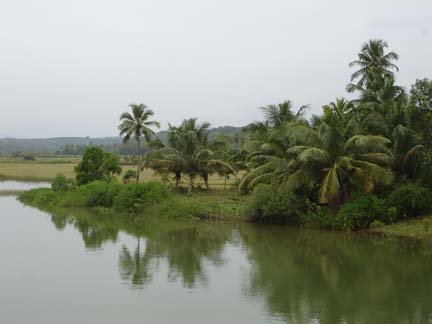
Holegadde near Honavar,Uttara Kannada dist, Karnataka
Copy? Right - but kindly remember to acknowledge!

" tulu-research.blogspot." ತುಳು ರಿಸರ್ಚ್. ಬ್ಲಾಗ್ಸ್ಪಾಟ್. ಇನ್

Have a nice day !