Thursday, January 10, 2008

69.Kaipunjal and Kapu


Friend Vish recently visited his relatives at Kaipunjal near Kapu. His poser on the word ‘Kaipunjal’, prompted me to analyse the meaning of the word.
Tulu people evidently loved the geography of their land since ancient times. This is amply illustrated by the fact that most of the habitations have been named after the salient geographical/ geomorphological features of the area.
Kai-punj-al
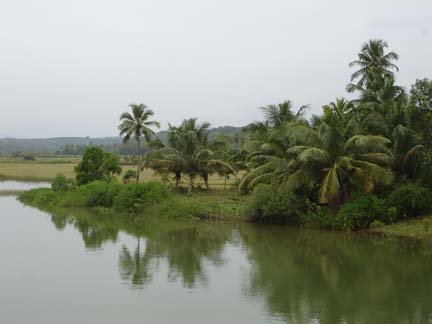
An explanation of the basic geomorphology of the Kaipunjal area, may help better appreciation of the word. The Kaipunjal habitation is north of Kapu village, located about 10 kilometers southwest of Udupi town. Udyavara river flows westerly towards the coast and further takes a long northward turn parallel to the coastline upto Malpe town, where it joins the Arabian Sea. There is a small southward blind tributary to River Udyavara that flows (or rather fills up) mainly during the rainy season. The name ‘Kaipunjal’ evidently refers to the seasonal inflated stream-limb.
The word Kai+punja+al therefore means tributary/branch (=‘kai’) of swollen/surged (=‘punja’) river (=‘Aal’). The word ‘punj/panj’, apparently derived from our ancient Munda heritage, is the root of Tulu words ‘panji’ (=swollen animal) as well as ‘panja’ and ‘punja’ (=raised/ inflated land).The word 'panja' still exists in Kui (Gondwana)langauage.
Kapu
The word ‘Kapu’ means a reserved or protected area, possibly derived from the protected status of area during the period of regal armies. Possibly, an army of soldiers was kept at Kapu area during historical period when Udyavara was under the rule of Kings/Chieftains.

A ‘kapi-kad’ represented reserved forest of earlier days. A community of ancient guards is called ‘Kapu’ in Andhra Pradesh. The verb ‘kapu’(<.kapuni) in Tulu also means to wait.

Tuesday, January 8, 2008

Nature-scape ..4


Sahyadri range of hills at Charmadi,Belthangadi Taluk.

68. Pandavara kallu: Neolithic tombs


On the Bantwal –Belthangadi road, take a deviation at Madyanthar township off Uppinangadi cross road for about three kilometers, you shall reach Pandavara kallu, a site of archeological importance that forms a part of Badaga Kajekar village (Belthangadi taluk, Dakshina Kannada district.).
Archeological site
The name ‘Pandavara kallu’ (Stones of Pandava) has come from an odd group of stone structures consisting of erect slabs of granite, covered by flat slabs of granite. Eye witnesses inform that the structure was intact several years ago but now dilapidated with stone slabs scattered helter-skelter thanks to the intervention of land developers as well as irresponsible urchins. However, a local institution has put up a sign post declaring the area as historical monument.
Sasandiri
The structure was called 'Stones of Pandavas' because of their large size. Local people believed that Pandava brothers on exile came and lived in this village for some time, hiding inside these stone structure specially created by them.
But this assumption of local people may not be true. The structure is a megalithic burial structure called ‘dolmen’ or ‘Sasandiri’.(Sasan=burial ground or ‘Smashan’; diri=erected stone slabs) among Munda tribes.Similar Neolithic 'dolmen' burial structures have been reported from different parts of the world. Malini Srivastava (2007) in a research paper, available online, describes the ‘Sasandiri’ burial structures prevalent among Munda tribes of Chotanagapur.
Significance
The stone burial structure (Sasindiri) at Pandavara kallu is a vestige of Early Munda culture that predated the present Tulu culture and civilization. It was a general practice among the early tribes to bury the dead, before the arrival of Tulu immigrants, ca. 800-600BC, who introduced the custom of cremating the dead bodies. The notion of cremation of dead bodies was initiated during the cemetery H culture of Indus valley.
There could many more such vestiges, unreported and lying in various stages of preservation in other remote corners of the District. Those who can recognize such structures should make it a point to report them promptly to the archeologists/historians for further studies.

Monday, January 7, 2008

67. Bunts and Nairs

Contributed by Narayana T.Shetty

The tulu proverb says ”mara puttinalpane, naramani poyinalpane” (tree remains where it grown, man remains anywhere he goes). But a curiosity to know our past, origin still remains in major parts of human beings, including Bunts.
According to paDdanas (oral tradition of tuluva legends) we came from aichatra maDastana. This ahichchatra according to “purananaama choodamani” is a city in uttara paamchaala country of Drupada, the father of Draupadi. This is in “Uttaranchala” state today which is surrounded by Tibet in north and Nepal on east. The city is now called “Ram Nagar”.
According to another legend ahikshetra was a place on the banks of Saraswati river. “ahi” means snake (chiefly serpent). It is believed that we Bunts were “naga or serpent worshipers prior to being buta/boota or spirit worshipers. Of course, we worship our ancestors in spirits (kule) too and thus have various ways/rituals to pray and remember them (agel to kulekulu, new dress to kulekulu, marriage of kule etc.). So there is reason to believe that bunts were mainly serpent worshipers and many groups of us might have come from north.
Nairs or Nayars and bunts belong to same cast. Like Bunts and Nadavas (and other tuluva people) Nairs too follow their own form of inheritance called Marumakkathayam, which is “ali katt”. Bunts have “Nayaranna bali” (bali = matriarchal lineage). Last ruler/king of Kanajar (a village in Karkala Taluk) was Nayar Hegde. In this village it was prohibited to take name of the king. So Kanajar folks always called the plough equipment commonly known as nayer/naver in tulu as guddal (from kannada ‘guddali’). The royal house (oMjane ill) of my village Kowdoor (adjacent to Kanajar) is “Naayara bettu”. Nayara is one of the 93 Bunts surname. Varma is a common surname of Nairs and Bunts.
According to K. M. Parinikar "The Nayars [Nairs] were not a caste, they were a race”. Some think nair is the honorific plural of nayan which is derived from the Sanskrit nayaka (leader).
Again “Nayak” is a Bunts surname, mainly from Nakre village in Karkala Taluk. Majority of Nadavas of North Canara have got surname Nayaka. Father of famous queen Chennamma was Siddappa Shetty and her husband was (Siva) Nayaka.
Others derive nair from the naga (snakes) which they worship. The Brahmin-inspired Keralolpathi regards them as the descendants of the Sudras who accompanied the Brahmin immigrants from outside Kerala. There is a theory that they came from the Nepal Valley, adjacent to Tibet. Some consider them to be early descendants of the Newars of Nepal. Serpent worship is one of common custom between the Newars and Nairs. Dr. Zacharias Thundy’s theory is that groups of Newars who were partially Aryanized and would be later Dravidianized joined the Munda exodus and finally settled down in Kerala after a long period of sojourn in the eastern plains of Tamil Nadu. The Nairs were in Kerala before the Brahmins arrived in the seventh century A.D. The Chera kings were Nairs, and the Nairs were also Dravidians and not Kshatriya Aryans; the Brahmins, in fact, considered them as Sudras.
If I am not wrong “Mundal” of Tulunadu and the “Munda” have same synonym.
There is also a belief that the Nairs are Nagas and were already present in Kerala when Namboodiris came to Kerala. Nairs were martial Dravidian Nagas who had migrated like them, from the North. Like Bunts, affinity of the Nair community to Serpents and Serpent worship is indisputable. The mythical version says that Nairs being Kshatriyas belonging to the Nagavansham who removed their “Janivara” (sacred thread) and escaped to south to evade Parasurama. In the old Tamil texts, the Nairs were mentioned as Naka (Naga) Lords who ruled as feudal lords in the Chera kingdom.

-Contributed by N.T.Shetty

Sunday, January 6, 2008

Topic Index : posts 1-66

Tulu language
1. Tulu Language: Origin and Evolution/Feb.07
13.The Tulu script: Origin and Revival/Apr 07
14. Evolution of the Kannada script. ./Apr 07
43.Evolution of Tulu language. ../Oct 07

Tulu words
2. Traces of Tulu-Kannada-Dravida words in ..Sumerian .. /Feb.07
5. Mundkur, Munder /Feb.07
7 .Banta, Bantu /March 07
8. Banta, Bantu II. /March 07
15. A charming Tulu word: naDeer. ./Apr 07
25.Pala and antiquity of Tulu words /June 07
36.Planets as Tulu proper names. /Sep 07
41.Origin of the word: Tulu I. ../Oct 07
42.Origin of the word: Tulu II. ../Oct 07
45.Origin of the word: Bant’ ../Oct 07
57.A word that traveled: Ayana./Dec 07
63.Baikampadi./Dec 07
64.Puraal and Polali./Dec 07
65.Mayi-kala at Mangalore/ Jan 08

Evolution- Migration-Pirak
3. Pirak,Prak and Prakrit /Feb.07
31.Tulu migration from Pirak1000-600BC. ./Aug 07
37.Early human migrations. /Sep 07
44.The scale of human migration.. ../Oct 07
46.Proto-Tulu migration Stage I ../Oct 07
48.Early Tulu Stage II: 2000-800BC../Oct 07
51.Stage III: Migration from Pirak. 800-500BC. ../Oct 07


Religious concepts/cults: Origin
4. Brahma worship. Brahma and Bermer./ Feb.07
6. Bermer II. /Feb.07
26.Origin of the concept of Brahma. /June 07
28.Significance of Brahma./Aug 07
32.Animal and Spirit worship /Sep 07
33.Brahma-Vishnu-Mahesha. /Sep 07
34.Ten incarnations of Vishnu. /Sep 07
35.Ancient Spirit worship: Horse-mounted Heroes. /Sep 07
50.The legend of Rama. ../Oct 07
54.The legend of Bali./Nov 07
60.The original Rama./Dec 07
62.Characterization of Spirits..1../Dec 07


Moolasthana-Taravada
9. The Moolasthana Concept. /April 07
18. Location of Moolasthanas ./Apr 07
19. Moolasthana. ./Apr 07
30.Multan and Moolasthana. ./Aug 07
66.Taravada concept


Fruits,Tubers and Food
10. Evolution of culinary habits./Mar 07
11. Boiled grains to steam cooked Idlis/Mar 07
12. Rotis: Early oil free roasted vegetarian food./Apr 07
20. Earliest popular fruit.:(Jack). ./Apr 07
21.Taste of Tulunadu. ./Apr 07
22. Taste of Tulunadu.2 ./Apr 07
23. Boiled grains to Idlis: An update. /May 07
24.Chakku palam>Jack fruit. /May 07
25.Pala and antiquity of Tulu words /June 07
27.The Sweet Potato. /June 07
29.The Rice: Vrihi and Arih. ./Aug 07
47.Mundevu (Pandanus). ../Oct 07
61.Native tubers/Dec 07

Mangalore geography -history
16. Mangalore: Kudla and Nitria. ./Apr 07
17. Historic Mangalore:Port of Bukkapatna. ./Apr 07

Evolution-Early Munda civilization
37.Early Human migrations/Sep 07
38.Earliest Indian tribes. /Sep 07
39.One human family../Oct 07
40.Early evolution of words and languages. ../Oct 07
49.Early human settlements in Southern India. ../Oct 07
52.Munda aborigines of Karavali./Nov 07
53.More on Munda influence on Tulu./Nov 07
55.Identity of Neolithic south Indians. /Nov 07
56.Assimilation of Indo-Aryans. /Dec07
58.Evolution of Early Communities./Dec 07
59.The less evolved ancient tribes/ Dec 07

Ruminations
Language and Culture /Feb.07
Random Ruminations /March 07
A Tulu stage play: Kariyajjerna Kathekulu. ../Oct 07

66.Taravada concept

The Nairs of Malabar have traditionally adapted to the custom of Taravada, which is a custom of reverence to the original joint-family house. The Nairs, are considered to have been immigrants from Nepal who settled in the West coast (Karavali and Malabar) during the early centuries of the Christian era. In Nepal they were known as Neyers, according to Zacharias Thundy. The immigrant Nair fraction settled in Tulunad adapted to farming and subsequently merged with local farmers, the ‘Okkelakulu’(Gururaja Bhat,1970). Thus as a consequence of assimilation of Nair fractions that followed Theravada customs, the Tulu farming community, now known as ‘Bunts or Nadavas’ have also adapted to the Taravada custom. This indirectly suggests that Buddhism was prevalent in Tulunadu, along with the cult of spirit worship, in the early centuries of the Christian Era.
Moolasthana and Taravada
The concept is chronologically later extension and evolution of the ‘Moolasthana’ concept. The ‘Moolasthana’ concept (origin and development: ca. 2000-800 BC) emphasized on the original place (hamlet or part of village) of settlement which was held sacred for the progeny of the particular group or clan (which may include several later formed communities).Whereas the Taravada or Theravada concept evolved during early Buddhist period, derived from the Theravada school (ca. 250 BC), concentrated on the reverence to the Family house of origin. The chronological evolution of notion of original habitation to original family house is notable.
Buddhist school
The concept and school of Theravada Buddhism, coincides with the life and times of King Ashoka. Theravada in Pali language means the ‘path of the elders’. [Theravada (Pali)> Sthavira-vada (Sanskrit)]. It is said that the Nairs were brought along with Brahmins by Kadamba King Mayura Sharma (ca.450 AD) to maintain newly built temples of Tulunadu. However, available evidences point to the existence of Buddhism in Tulunadu (Mayi kala and Kadarika Vihar, at Mangalore).Thus it is not clear at this moment whether the Buddhist concept of ‘Taravada’ was introduced to Tulunadu/Malabar by the Nairs or by other Buddhist monks that arrived here before the Nairs.
Gujarat connection
The word Taravada has several connections with Gujarat. Taravada, incidentally, is also the name of a village in the Amreli district of Gujarat. There is another Haripar Taravada village in Lodhika Tehsil of Rajkot district of Gujarat. In Gujarat, presently some Vaishnav Gurukuls like Swami Narayan are also called Taravada.

Friday, January 4, 2008

65. Mayi-kala at Mangalore


Left:An image of Queen Mayadevi in Nepali-Tibetan Art form

Who is the first patron Godess of Mangalore city? If you ask this question to any of the bright kids of this city, you are likely to get the answer: Mangaladevi. Yes, it is true that Mangalore city is named after a Queen of Malabar called ‘Mangale’ who visited this place in the early 10th century and expired here on account of her ill-health.
Mayadevi
But, analysis of the available stray strings of historical data on Mangalore suggests that there was another Queen, who lent her name to the city before Mangale came here! That was, incidentally, the Queen Mayadevi of Lumbini, Nepal. Mayadevi was the mother of prince Siddartha who became famous as Gautama Buddha and founded the religion of Buddhism. During the initial phase of Buddhism, the Theravada school, there was no worship of idols or Gods. Further, during Mahayana period, Mayadevi and Buddha were worshipped. Mahayana school of Buddhism itself is said to have been originated in Southern India, as a result of movement to reach Buddhism to the masses ca.100 CE and became influential and active during 2nd to 5th century CE.
Mayi kala
A historical temple devoted to Mayadevi, mother of Gautama Buddha / Siddartha, is found in Lumbini, Nepal. During the early centuries of Christian Era the ancient Mangalore was evidently under the influence of Buddhism. A similar temple devoted to Mayadevi existed in the ancient Mangalore city, somewhat built in the local style of ‘saana’ or ‘kaLa’ devoted to spirits. Possibly, here she was worshipped as a spirit Godess. The Tulu word ‘kala’ is derived from the Early Munda language, meaning ‘a holy field’ (temple or ‘saana’) devoted to spirits. The ‘Mayi-kala’, the ‘kaLa’ devoted to Mayadevi (‘Mayi’) existed in heart of ancient town of Mangalore.
It is customary to designate localities using names of nearest landmarks. For example, the locality name ‘Hampana-katta’ in Mangalore was derived from a small ‘katte’( a rectangular structure for sitting under the shade of a tree) used by one philanthropic Appanna, some hundred year ago, to dispense drinking water to the passers by. Similarly the ‘Lalbagh’ locality in Mangalore is named after a house in the locality called ‘Lalbagh’!
In this way, the town area around Mayi kala was called Mayi kala. The name Mayi kala was applied to the old town of Mangalore. The said Mayi kala (place of Buddhist worship) may have been destroyed later due to change of faiths by the rulers or due to dominance of other schools of religious thoughts.
Nepal connection
The existence of a temple devoted to Mayadevi at Mangalore, suggests transfer of people, ideas and relations between Nepal and Mangalore on the West Coast during the early centuries of the Christian Era.
Beary community
The members of the Beary merchant community of Karavali and Malabar, who frequented the ancient township around Mayi kala, used this word to refer to the city of Mangalore since historical days and continue to use the word ‘Maikala’ even today, while other communities have totally forgotten about the origin or significance of the word Maikala.
In this way, the Bearys have preserved a significant string in the historical and cultural vestige of ancient Mangalore, and an evidence for prevalence of Buddhism in Tulunadu during ethe Early centuries of the Christian Era.
.

Blog Archive

Books for Reference

  • A Comparative Study of Tulu Dialects By Dr. Padmanabha Kekunnaya. Govinda Pai Reserach Centre, UDupi. 1994
  • Koti Chennaya: Janapadiya Adhyayana. By Dr. Vamana Nandavar. Hemanshu Prakashana ,Mangalore.2001.
  • Male kudiyaru. Dr B. A.Viveka Rai and D.Yadupathi Gowda, Mangalore University,1996.
  • Mogaveera Samskriti By Venkataraja Punimchattaya. Karnataka Sahitya Academy.1993.
  • Mugeraru:Jananga Janapada Adhyayana. By Dr Abhaya Kumar Kaukradi.Kannada & Culture Directorate,Bangalore & Karnataka Tulu Academy, Mangalore,1997.
  • Puttubalakeya Pad-danagalu. Ed: Dr B.A.Viveka Rai,Yadupati Gowda and Rajashri, Sri Dharmasthala Manjunatheswara Tulu Peeta. Mangalore University.2004
  • Se'erige. Ed:Dr K.Chinnapa Gowda.Madipu Prakashana,Mangalagangotri,2000.
  • Studies in Tuluva History and Culture.by Dr P Gururaja Bhat (1975).Milagres College,Kallinapur,Udupi.
  • Taulava Sanskriti by Dr.B.A.Viveka Rai, Sahyadri Prakashana,Mysore 1977
  • TuLu naaDu-nuDi By Dr.PalthaDi Ramakrishna Achar, Puttur.
  • TuLu NighanTu. (Editor in Chief: Dr U.P.Upadhyaya, Govinda Pai Research Centre,Udupi. Six volumes. 1988 to 1997
  • Tulu Patero-A Philology & Grammar of Tulu Language by Budhananda Shivalli.2004.Mandira Prakashana Mangalore. p.317. (The book is in Tulu Language using Kannada script)
  • TuLunadina ShasanagaLa Sanskritika Adhyayana. By Shaila T. Verma (2002) Jnanodaya Prakashana,Bangalore, p.304.(Kannada)
  • Tuluvala Baliyendre. Compiled by N.A.Sheenappa Hegde,Polali,Sri Devi Prakashana,Parkala,1929/1999

A Coastal estuary

A Coastal estuary
Holegadde near Honavar,Uttara Kannada dist, Karnataka

Copy? Right - but kindly remember to acknowledge!

Creative Commons License
This work is licensed under a Creative Commons Attribution 3.0 License.

" tulu-research.blogspot." ತುಳು ರಿಸರ್ಚ್. ಬ್ಲಾಗ್‌ಸ್ಪಾಟ್‌. ಇನ್

" tulu-research.blogspot."  ತುಳು  ರಿಸರ್ಚ್.  ಬ್ಲಾಗ್‌ಸ್ಪಾಟ್‌. ಇನ್
Have a nice day !